All-on-4 vs All-on-6 Dental Implants in Vietnam
Compare All-on-4 and All-on-6 full-mouth dental implants in Vietnam. Biomechanical differences, bone density criteria, costs, and clinic selection guide.
By Đội ngũ DentalTreatmentVietnam · Medically reviewed by a licensed dental surgeon · Last updated: October 12, 2026
A note on prices: All prices in this article are shown as indicative ranges (not fixed quotes) and were last reviewed in October 2026. Your clinic will confirm an exact written quote before treatment begins.

Four implants or six? It is the question every full-arch patient asks, and the honest answer is: it depends on your bone, your bite, and your budget. Here is how dentists actually make the call.
For patients experiencing terminal dental breakdown, widespread decay, severe periodontitis, or decades of frustration with loose dentures, full-arch dental implant rehabilitation represents a profound, life-changing transition. Modern oral surgery no longer requires placing an individual implant for every missing tooth. Instead, full-arch protocols restore an entire jaw of teeth using either four or six strategically engineered titanium anchors.
When researching full-mouth restorations, international patients routinely encounter the primary clinical dilemma: Should you choose All-on-4 or All-on-6?
This clinical guide provides an objective, evidence-based biomechanical comparison between All-on-4 and All-on-6 implant systems. We break down the anatomical indications, bone volume thresholds, bite-force dynamics, material options, and exact pricing available across certified dental hospitals in Vietnam.

1. Biomechanical Fundamentals: How Both Protocols Function
Both All-on-4 and All-on-6 are fixed, screw-retained implant prostheses designed to permanently replace an entire arch of upper or lower teeth. Unlike removable dentures, these restorations do not slip, click, require messy adhesives, or cover the sensitive palate of the mouth.
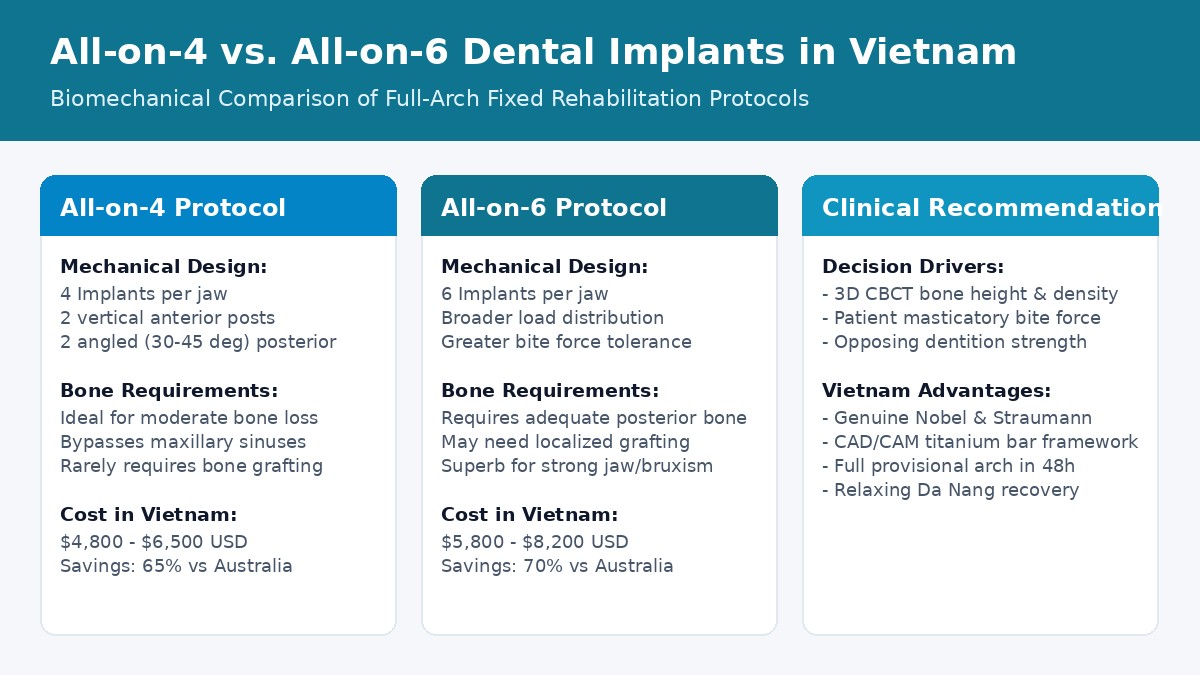
ARCHITECTURAL LOAD-BEARING COMPARISON
| ALL-ON-4: Front: [Post 1 (Vertical)] [Post 2 (Vertical)] Sides: [Post 3 (Tilted 30-45°)] [Post 4 (Tilted)] Span: 10 to 12 teeth supported | Shorter posterior cantilever |
|---|---|
| ALL-ON-6: Front: [Post 1 (Vertical)] [Post 2 (Vertical)] Mid: [Post 3 (Vertical)] [Post 4 (Vertical)] Sides: [Post 5 (Vertical/Angle)] [Post 6 (Angle)] Span: 12 to 14 teeth supported | Minimal cantilever, max load distribution |
The All-on-4 Protocol
Developed by Portuguese oral surgeon Dr. Paulo Malo in collaboration with Nobel Biocare in the late 1990s, the All-on-4 technique solved the historic barrier of bone resorption:
- Two Anterior Implants: Placed vertically in the dense frontal bone of the jaw where bone loss is minimal.
- Two Posterior Implants: Angled backwards at 30 to 45 degrees.
- The Tilted Advantage: Angling the rear fixtures achieves three critical objectives: it increases the surface contact area between bone and titanium, engages denser cortical bone, and physically bypasses the maxillary sinuses (upper jaw) and the mental nerve canal (lower jaw).
Because it circumvents anatomical hazards, All-on-4 allows thousands of edentulous patients to avoid invasive bone grafts and sinus lifts.
The All-on-6 Protocol
The All-on-6 technique builds upon the same osseointegration principles but introduces two additional titanium posts into the posterior premolar and molar regions:
- Provides six load-bearing pillars across the entire parabolic arch.
- Distributes masticatory chewing forces across 50% more contact area than a 4-implant array.
- Allows dental technicians to extend the prosthetic bridge to 14 teeth (full first and second molar occlusal support), eliminating the posterior cantilever overhang.
To review basic implant anatomy before diving deeper, explore our foundational guide: What is a Dental Implant? Complete Beginner's Guide.
2. Anatomical & Clinical Criteria: Which System Fits Your Mouth?
The decision between four and six implants is not simply a matter of "more is better." Rather, it is determined by precise diagnostic indicators captured during a high-resolution 3D Cone Beam Computed Tomography (CBCT) scan.
| Evaluation Factor | All-on-4 Candidate Profile | All-on-6 Candidate Profile |
|---|---|---|
| Jawbone Volume | Moderate to advanced bone atrophy; shallow sinus floor | Good to excellent bone height and width in rear jaw |
| Chewing Bite Force | Normal to moderate mastication force; petite or average jaw | High bite forces; broad jaw; history of bruxism (grinding) |
| Need for Bone Graft | Rarely required; angled posts bypass nerve & sinus spaces | Occasionally requires minor grafting in posterior regions |
| Number of Teeth Restored | Typically 10 to 12 prosthetic crowns (up to 1st molar) | Typically 12 to 14 prosthetic crowns (full 2nd molar table) |
| Surgical Complexity | Streamlined; less invasive osteotomy requirements | Requires 6 osteotomies; more extensive surgical site |
When Oral Surgeons Strongly Recommend All-on-4
1. Severe Posterior Bone Loss: When long-term tooth absence has caused the sinus cavity to pneumatize (expand downward) or the lower jaw ridge to thin, placing vertical rear implants is anatomically impossible without extensive sinus lifts or nerve transposition. The 45-degree angled posts of All-on-4 provide rock-solid primary stability without grafting.
2. Medical Vulnerabilities: Older patients or individuals with controlled systemic conditions (such as mild diabetes or controlled hypertension) benefit from shorter surgical duration and less soft-tissue reflection.
3. Budgetary Optimization: For patients wanting a permanent, fixed restoration while staying within a defined budget, All-on-4 provides full clinical function at a noticeably lower overall fee.
When Oral Surgeons Strongly Recommend All-on-6
1. Younger, Robust Patients with High Bite Forces: Male patients, individuals with wide mandibular arches, and muscular masticatory profiles generate enormous occlusal pressures (often exceeding 600–800 Newtons). Six implants dissipate these forces evenly, preventing mechanical fatigue on prosthetic screws.
2. Abundant Natural Bone: When the patient has retained good ridge dimensions, placing six implants maximizes long-term redundancy. If one implant should experience complications decades later, the remaining five fixtures can often continue supporting the restoration.
3. Opposing Natural Dentition: If the restored arch will bite against healthy natural lower teeth (which exert far greater force than a denture), six fixtures provide superior biomechanical resistance.
To understand how individual tooth replacements compare to these full-arch solutions, see: Single vs Multiple vs All-on-4 Implants: Which Do You Need?.
3. Cost Breakdown: Vietnam vs Australia & United States
Full-arch rehabilitation is historically one of the most expensive medical procedures in Western nations. In Australia, the UK, and North America, lab fees, component markups, and surgeon overhead push single-arch treatment out of reach for average families.
Accredited dental centers in Vietnam utilize identical Swiss (Straumann), Swedish (Nobel Biocare), and Korean (Dentium/Osstem) hardware, yet deliver full-arch treatment at a fraction of Western costs.
| Treatment Category | Australia (AUD $) | Vietnam Certified |
|---|---|---|
| All-on-4 (Nobel Biocare / Straumann) Complete Arch with Final Zirconia | $26,000 – $34,000 AUD ($17,500 – $23,000 USD) | $7,200 – $9,800 AUD ($4,800 – $6,500 USD) |
| All-on-6 (Nobel Biocare / Straumann) Complete Arch with Final Zirconia | $32,000 – $42,000 AUD ($21,500 – $28,000 USD) | $8,800 – $12,300 AUD ($5,800 – $8,200 USD) |
| Full Mouth Both Arches (All-on-4) Top & Bottom Fixed Teeth | $52,000 – $68,000 AUD ($35,000 – $45,000 USD) | $14,000 – $19,000 AUD ($9,500 – $12,800 USD) |
Why Does Vietnam Offer Over 65% Savings?
These substantial savings stem entirely from structural economic factors, not reduced clinical standards:
- Operational Overhead: Clinic rents, dental assistant salaries, and commercial utility rates in Vietnam are significantly lower than in Sydney, London, or Los Angeles.
- In-House Digital Milling Centers: Major centers in Da Nang and Ho Chi Minh City operate dedicated German CAD/CAM milling facilities, eliminating high third-party laboratory middleman charges.
- Favorable Currency Valuation: Strong foreign currencies (AUD, USD, EUR, GBP) purchase exceptional clinical expertise and luxury hospitality in Vietnam.
For full regional price comparisons, read: [Dental Implants Cost: Vietnam vs. Australia vs. USA [2025]](https://dentaltreatmentvietnam.com/services/dental-implants/implant-cost-vietnam-vs-australia) and explore our curated holiday packages in All-Inclusive Dental Treatment Packages in Vietnam.

4. The Two-Trip Treatment Timeline in Da Nang, Vietnam
Full-arch rehabilitation is performed in two structured phases to guarantee complete biological safety and flawless prosthetic craftsmanship.
Trip 1: Surgical Placement & Fixed Provisional Teeth (7 – 10 Days)
- Day 1: Comprehensive Diagnostics: High-resolution 3D CBCT scanning, 3D intraoral scanning, digital smile design simulation, and consultation with your lead oral surgeon.
- Day 2: Guided Surgery: Atraumatic removal of non-restorable teeth, precision placement of 4 or 6 titanium fixtures using computer-guided surgical guides, and immediate placement of multi-unit abutments under IV sedation or local anesthesia.
- Day 3: Digital Bite Verification: The dental lab digitally designs your immediate provisional bridge.
- Day 4 – 5: Provisional Loading: A fixed, aesthetic acrylic hybrid bridge is screwed directly into your implants. You walk out of the clinic with a complete, non-removable set of functional teeth!
- Day 6 – 8: Healing & Seaside Relaxation: Enjoy gentle coastal walks along Da Nang's My Khe beach and dine on nourishing soft Vietnamese soups.
- Day 9 – 10: Suture Check & Fit-to-Fly Clearance: Final clinical wound assessment, issuance of fit-to-fly certificates, and departure for home.
The Intermediary Healing Period (4 to 6 Months)
Back in your home country, the bone cells integrate tightly around the titanium threads (osseointegration). You continue eating a soft-to-medium diet with your fixed provisional teeth. Your clinic maintains monthly remote check-ins via digital photos and WhatsApp.
Trip 2: Final Monolithic Zirconia Prosthesis (5 – 7 Days)
- Precision Impressions: Master digital optical scans record your matured gingival contours.
- Aesthetic Trial: Verification of tooth shade, facial midline, lip support, and bite alignment.
- Final Delivery: The final CAD/CAM monolithic zirconia arch, reinforced with an internal titanium substructure bar, is torqued into place. You leave with permanent, unbreakable teeth designed for a lifetime of chewing.
To read about day-by-day healing expectations, consult: Dental Implant Recovery Timeline: Day 1 to Day 90 and inspect local hospital ratings on Da Nang Dental Hub.
Practical tip: Ask your surgeon to show you your CBCT scan and explain the choice for your case. All-on-4 and All-on-6 are protocols, not products — the right number of implants is the number your bone can support.

Frequently Asked Questions (FAQ)
What is the mechanical difference between All-on-4 and All-on-6?
All-on-4 uses four titanium implants per arch (two straight in front, two angled up to 45 degrees in back) to support a 10-to-12 tooth bridge without bone grafting. All-on-6 uses six implants placed along the arch to support a 12-to-14 tooth bridge, providing broader load distribution and greater resistance against heavy chewing forces.
Can I choose All-on-6 if I have severe jawbone loss?
Not always without prior bone grafting. All-on-6 requires sufficient posterior jawbone volume to anchor the additional two rear implants. If a 3D CBCT scan reveals severe bone atrophy near the sinus floor or lower nerve canal, All-on-4 is often the preferred, safer choice because its tilted posterior implants bypass deficient areas.
How much can I save on All-on-4 or All-on-6 in Vietnam compared to Australia or the US?
In Australia, a single arch of All-on-4 typically costs $25,000 to $35,000 AUD ($16,500 to $23,000 USD), and All-on-6 ranges from $30,000 to $42,000 AUD. In accredited Vietnam clinics, a complete All-on-4 arch costs $4,800 to $6,500 USD ($7,200 to $9,800 AUD), and All-on-6 ranges from $5,800 to $8,200 USD ($8,800 to $12,300 AUD)—yielding net savings of 65% to 75%.
How long does full-arch implant treatment take in Da Nang, Vietnam?
The initial surgical phase requires 7 to 10 days in Vietnam. During this visit, teeth are extracted, implants are placed, and an immediate fixed provisional acrylic bridge is screwed onto the implants within 48 to 72 hours. Patients return home to chew comfortably during the 4 to 6 months of osseointegration, before returning for a final 5-to-7 day visit to receive their permanent monolithic zirconia arch.
Is All-on-6 always better than All-on-4?
Not necessarily. More implants can mean better load distribution, but they also need sufficient bone volume and cost more. Many patients get decades of service from four well-placed implants. The decision should follow your scan, not a menu.
How long does a full-arch bridge last?
The titanium implants themselves can last decades with good care; the prosthetic bridge typically needs maintenance or replacement after 10–15 years of daily use. Ask what your warranty covers for each part separately.

Transform Your Smile with Expert Full-Arch Care in Vietnam
Whether your jaw anatomy calls for the streamlined efficiency of an All-on-4 or the heavy-duty load distribution of an All-on-6, Vietnam's internationally accredited dental centers deliver life-changing transformations in a world-class resort destination.
---
This article is for informational purposes only and is not medical advice. Please consult a qualified dentist for diagnosis and treatment options.
What is the mechanical difference between All-on-4 and All-on-6?
All-on-4 uses four titanium implants per arch (two straight in front, two angled up to 45 degrees in back) to support a 10-to-12 tooth bridge without bone grafting. All-on-6 uses six implants placed along the arch to support a 12-to-14 tooth bridge, providing broader load distribution and greater resistance against heavy chewing forces.
Can I choose All-on-6 if I have severe jawbone loss?
Not always without prior bone grafting. All-on-6 requires sufficient posterior jawbone volume to anchor the additional two rear implants. If a 3D CBCT scan reveals severe bone atrophy near the sinus floor or lower nerve canal, All-on-4 is often the preferred, safer choice because its tilted posterior implants bypass deficient areas.
How much can I save on All-on-4 or All-on-6 in Vietnam compared to Australia or the US?
In Australia, a single arch of All-on-4 typically costs $25,000 to $35,000 AUD ($16,500 to $23,000 USD), and All-on-6 ranges from $30,000 to $42,000 AUD. In accredited Vietnam clinics, a complete All-on-4 arch costs $4,800 to $6,500 USD ($7,200 to $9,800 AUD), and All-on-6 ranges from $5,800 to $8,200 USD ($8,800 to $12,300 AUD)—yielding net savings of 65% to 75%.
How long does full-arch implant treatment take in Da Nang, Vietnam?
The initial surgical phase requires 7 to 10 days in Vietnam. During this visit, teeth are extracted, implants are placed, and an immediate fixed provisional acrylic bridge is screwed onto the implants within 48 to 72 hours. Patients return home to chew comfortably during the 4 to 6 months of osseointegration, before returning for a final 5-to-7 day visit to receive their permanent monolithic zirconia arch.
Is All-on-6 always better than All-on-4?
Not necessarily. More implants can mean better load distribution, but they also need sufficient bone volume and cost more. Many patients get decades of service from four well-placed implants. The decision should follow your scan, not a menu.
How long does a full-arch bridge last?
The titanium implants themselves can last decades with good care; the prosthetic bridge typically needs maintenance or replacement after 10–15 years of daily use. Ask what your warranty covers for each part separately.
Dental Tourism Vietnam Cost: Complete Price Guide & Financial Planning 2026
Save 70-80% on dental care in Vietnam. Complete 2025 cost guide, procedure comparison vs Australia/US/UK, payment methods, hidden fees & net ROI calculator.
Complete Cost Breakdown: Flight + Hotel + Treatment in Vietnam
Full out-of-pocket cost breakdown for dental tourism in Vietnam. Return flights, 4-star hotels, dental procedures, meals, and real patient budget models.
Dental Tourism Cost Calculator: How to Estimate Your Trip
Calculate your dental tourism savings in Vietnam. 4-step formula: clinic procedures + flights + resort stays + living expenses vs Western costs.
Independent Pre-Trip Resources for International Patients
To ensure your dental travel journey is seamless and well-prepared, we recommend consulting these independent destination and recovery travel guides:
"View the comprehensive pre-trip medical checklist at VietnamMedicalTravelGuide.com"
• Post-op soft food dining & culinary recovery in Vietnam
"View airport transit times and clinic neighborhood maps at DaNangDentalHub.com"
• Top 5-star beachfront resorts with clinic concierge shuttles