Bone Grafting Before Implants in Vietnam: Cost & Process
Learn about bone grafting and sinus lifts before dental implants in Vietnam. Procedure types, healing timelines, costs vs Western clinics, and safety protocols.
By Đội ngũ DentalTreatmentVietnam · Medically reviewed by a licensed dental surgeon · Last updated: October 12, 2026
A note on prices: All prices in this article are shown as indicative ranges (not fixed quotes) and were last reviewed in October 2026. Your clinic will confirm an exact written quote before treatment begins.

Being told you need a bone graft can feel like a setback. In practice, it is one of the most routine steps in implant dentistry — here is what it involves and what it fairly costs in Vietnam.
Receiving the news that your jawbone is "too thin" or "insufficient" for a dental implant can feel disheartening. Many patients assume that jawbone resorption disqualifies them from ever enjoying permanent, fixed replacement teeth again.
In modern maxillofacial implantology, however, bone deficiency is a routine, manageable condition. Through advanced alveolar bone augmentation and sinus lift procedures, skilled oral surgeons can regenerate dense, vital bone structure, transforming an inadequate jaw ridge into a solid foundation capable of supporting titanium fixtures for a lifetime.
If you are planning to travel for restorative care, this clinical guide to dental implants in Vietnam details the clinical indications, biomaterial choices, surgical techniques, recovery timelines, and exact pricing for bone grafting across top clinics in Vietnam.

1. Why Jawbone Resorption Occurs
Alveolar bone is a unique, dynamic tissue whose sole biological function is supporting natural teeth. When you chew, biting forces transmit down the tooth root and stimulate the surrounding bone cells (osteocytes), signaling the body to maintain bone mineral density.
The moment a tooth is lost to trauma, fracture, or periodontal disease, this vital mechanostimulation ceases:
- First 6 to 12 Months: The alveolar socket loses up to 40% to 60% of its horizontal width and significant vertical height.
- Long-Term Disuse: Over several years, the jaw ridge flattens into a narrow, knife-edge contour.
- Sinus Pneumatization: In the upper posterior jaw, the absence of molar roots causes the maxillary sinus cavity to expand downward, leaving only an eggshell-thin layer of bone separating the oral cavity from the sinus membrane.
Without grafting, placing an implant into deficient bone risks fixture exposure, nerve injury, sinus perforation, or early implant failure.
HEALTHY BONE vs. RESORBED JAW RIDGE
Healthy Ridge | Atrophied Ridge ```text +---------------+ +-------+
| [Implant] | | [Imp] | <-- Inadequate width! | | Titanium| | | |Titan| <-- Exposed threads! | | Fixture | | +-------+ | | 2mm Bone| | Bone thickness < 1mm +---------------+ ``` (High risk of failure) Abundant 3D Support Requires Bone Augmentation
| Crown | Crown | |
|---|---|---|
| =========== | ===== |
To understand the core anatomy of a titanium fixture, read: What is a Dental Implant? Complete Beginner's Guide.
2. The 3 Primary Types of Bone Augmentation in Vietnam
Depending on the three-dimensional geometry of your bone defect, your oral surgeon will select one of three proven augmentation protocols:
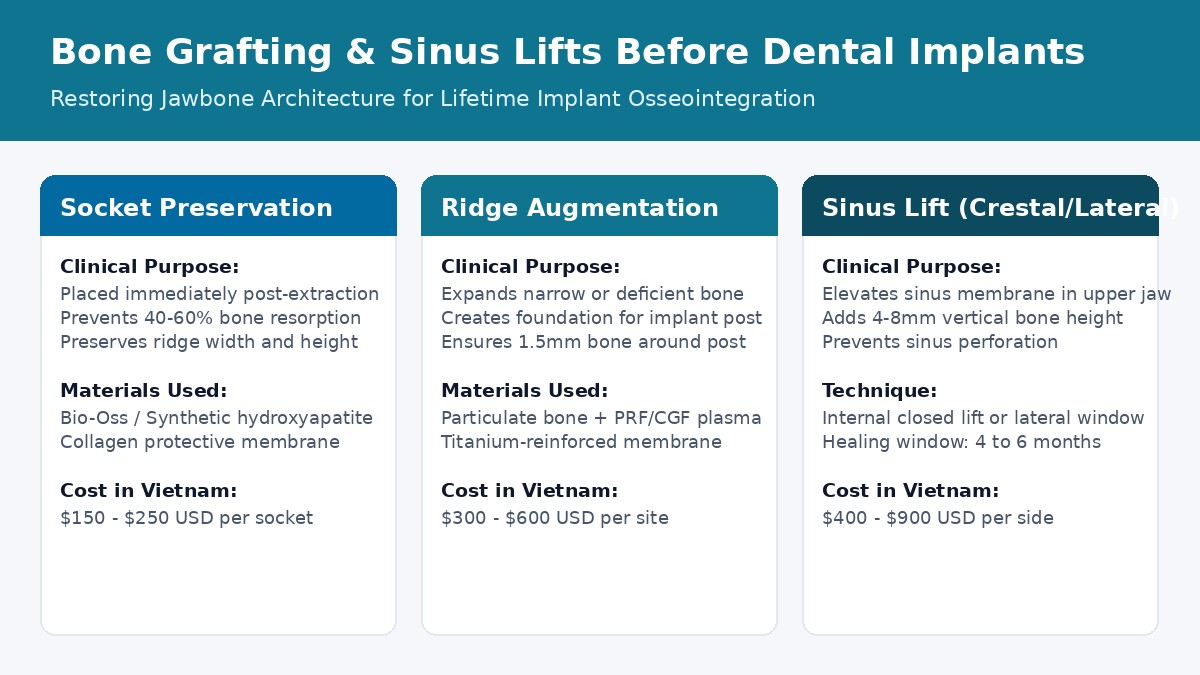
A. Socket Preservation (Extraction Site Grafting)
- When It Is Performed: At the exact moment a natural tooth is extracted.
- The Procedure: After gently removing the tooth root atraumatically, the surgeon cleans the socket thoroughly, packs it with mineralized particulate bone graft, and covers the opening with a collagen plug or protective membrane.
- Clinical Purpose: Acts as a biological scaffold that prevents the socket walls from collapsing during natural healing, ensuring the ridge retains ample volume for future implant placement.
B. Lateral Ridge Augmentation (Horizontal/Vertical Ridge Expansion)
- When It Is Performed: When a tooth has been missing for months or years and the remaining jaw ridge is too narrow (less than 5mm to 6mm wide).
- The Procedure: The surgeon reflects the gum tissue, places particulate bone graft along the outer surface of the jawbone, and covers the graft with a resorbable collagen membrane secured with micro-tacks.
- Clinical Purpose: Increases ridge thickness by 2mm to 4mm, guaranteeing that the titanium implant post will be completely encased in thick, healthy bone.
C. Sinus Lift (Maxillary Sinus Floor Elevation)
The upper molar and premolar region represents the most anatomically challenging zone in dental implantology due to the proximity of the maxillary sinus.
1. Internal (Crestal) Sinus Lift: Performed when the patient already has 4mm to 6mm of existing bone height and only needs 2mm to 3mm of additional vertical lift. The surgeon accesses the sinus floor through the implant osteotomy hole, gently taps the sinus floor upward, deposits bone material, and places the implant immediately.
2. Lateral Window Sinus Lift: Performed when severe bone atrophy leaves less than 4mm of residual crestal bone. The surgeon creates a tiny oval window in the lateral wall of the upper jaw, carefully lifts the delicate Schneiderian membrane, packs bone graft into the newly created pocket, and closes the site. Healing takes 4 to 6 months before implants are inserted.
To explore full-arch solutions that can bypass sinus lifts entirely, see: All-on-4 vs All-on-6 Dental Implants in Vietnam.
3. Advanced Biomaterials & PRF Technology Used in Vietnam
Accredited Vietnamese clinics utilize the identical internationally validated biomaterials found in leading Swiss, German, and American surgical suites:
- Geistlich Bio-Oss® (Switzerland): The undisputed global gold standard in bovine-derived xenografts. Its porous mineral architecture mirrors human cancellous bone, facilitating natural cellular ingrowth and long-term volume stability.
- Autogenous Bone Chips: Collected during site preparation using bone scrapers. Autogenous bone contains the patient's living osteoblasts, offering unmatched osteogenic potential.
- Platelet-Rich Fibrin (PRF / CGF): Modern clinics in Da Nang draw a small vial of the patient's blood prior to surgery and centrifuge it chairside to produce autologous fibrin membranes loaded with concentrated growth factors. PRF accelerates soft tissue closure, enhances capillary formation, and drastically cuts postoperative swelling.

4. Bone Grafting Costs: Vietnam vs Australia & United States
In Western healthcare markets, pre-implant surgical procedures carry steep surgical specialty fees, often adding thousands of dollars onto the total bill. In Vietnam, advanced bone procedures are priced affordably and transparently.
For complete pricing across all restorative treatments, review: [Dental Implants Cost: Vietnam vs. Australia vs. USA [2025]](https://dentaltreatmentvietnam.com/services/dental-implants/implant-cost-vietnam-vs-australia) and Dental Tourism Vietnam Cost: Complete Price Guide & Financial Planning.
| Surgical Procedure | Australia (AUD $) | Vietnam Certified |
|---|---|---|
| Socket Preservation (Per Tooth) | $600 – $1,200 AUD ($400 – $800 USD) | $220 – $370 AUD ($150 – $250 USD) |
| Lateral Ridge Augmentation (Site) | $1,500 – $2,800 AUD ($1,000 – $1,900 USD) | $450 – $900 AUD ($300 – $600 USD) |
| Internal Sinus Lift (Per Side) | $1,200 – $2,200 AUD ($800 – $1,500 USD) | $370 – $600 AUD ($250 – $400 USD) |
| Lateral Window Sinus Lift (Side) | $2,500 – $4,500 AUD ($1,700 – $3,000 USD) | $670 – $1,280 AUD ($450 – $850 USD) |
5. Recovery Protocol & Flying Home After Bone Grafting
Many dental tourists wonder whether bone grafting complicates their travel schedule. In reality, with minimally invasive surgical techniques, recovery is smooth and comfortable:
- Day 1 to 2: Minor swelling and localized bruising around the cheek or sinus area. Apply cold packs (20 minutes on, 20 minutes off). Take prescribed anti-inflammatory and antibiotic medications.
- Sinus Precautions (If You Had a Sinus Lift):
- Do NOT blow your nose vigorously for 14 days. If you sneeze, sneeze with your mouth wide open to prevent air pressure spikes inside the sinus cavity.
- Avoid drinking through straws or playing wind instruments.
- Take prescribed nasal decongestant sprays to keep nasal passages open.
- Flying Home: You can safely fly home 5 to 7 days post-surgery, provided your surgeon verifies clean mucosal healing and no sinus complications during your final follow-up exam.
To read about day-by-day healing, consult: Dental Implant Recovery Timeline: Day 1 to Day 90 and check top clinic standards on Da Nang Dental Hub.
Practical tip: Ask whether your graft uses your own bone, donor bone, or synthetic material. The type affects both cost and healing time, and your surgeon should explain why they chose it for you.

Frequently Asked Questions (FAQ)
Why do I need a bone graft before getting a dental implant?
When a natural tooth is extracted or lost to periodontal infection, the surrounding alveolar bone quickly atrophies, losing up to 40% to 60% of its width and height within the first year. A dental implant requires a minimum of 1.5mm to 2mm of healthy bone surrounding all sides of the titanium fixture for solid biomechanical anchoring. If your jawbone is too thin or shallow, a bone graft creates the essential biological foundation needed for lifetime osseointegration.
Can a bone graft and dental implant be performed at the same appointment?
Yes, in many clinical situations. If you have moderate bone deficiency but sufficient native bone to achieve solid primary implant stability (insertion torque >=35 Ncm), your oral surgeon can perform simultaneous implant placement and bone grafting. However, if bone loss is severe (ridge height under 4mm or severe horizontal resorption), a staged approach is required: the graft is placed first and allowed to mature for 4 to 6 months before the implant is surgically inserted.
How much does dental bone grafting cost in Vietnam compared to Australia or the US?
In Australia, a simple socket preservation graft costs $600 to $1,200 AUD ($400 to $800 USD), while complex sinus lifts or block grafts cost $2,500 to $4,500 AUD ($1,700 to $3,000 USD). In Vietnam, socket preservation costs $150 to $250 USD ($220 to $370 AUD), and advanced sinus lifts cost $450 to $850 USD ($670 to $1,280 AUD), saving international patients between 60% and 75% on advanced pre-implant surgery.
What bone graft materials do certified Vietnamese dental clinics use?
Accredited dental centers in Vietnam adhere strictly to FDA and CE-certified biomaterials. The most common graft used is Swiss Geistlich Bio-Oss (bovine-derived xenograft, the global gold standard), often combined with autogenous bone chips and Platelet-Rich Fibrin (PRF/CGF) concentrated from the patient's own blood to accelerate tissue vascularization and minimize infection risks.
How long do I wait after a bone graft before getting the implant?
Typically 3–6 months for the graft to integrate, depending on the graft size and material. Your surgeon confirms readiness with a follow-up scan — rushing this step is the main cause of graft failure.
Does bone grafting hurt more than the implant itself?
Most patients report similar or slightly more soreness than the implant placement itself, managed with standard pain relief for a few days. Swelling peaks around day two or three, then settles.

Build a Solid Foundation for Your New Smile in Vietnam
Do not let low bone density stop you from reclaiming your complete smile. Vietnam's premier maxillofacial surgeons leverage 3D guided planning, Swiss biomaterials, and gentle techniques to restore your jawbone with exceptional safety and savings.
---
This article is for informational purposes only and is not medical advice. Please consult a qualified dentist for diagnosis and treatment options.
Why do I need a bone graft before getting a dental implant?
When a natural tooth is extracted or lost to periodontal infection, the surrounding alveolar bone quickly atrophies, losing up to 40% to 60% of its width and height within the first year. A dental implant requires a minimum of 1.5mm to 2mm of healthy bone surrounding all sides of the titanium fixture for solid biomechanical anchoring. If your jawbone is too thin or shallow, a bone graft creates the essential biological foundation needed for lifetime osseointegration.
Can a bone graft and dental implant be performed at the same appointment?
Yes, in many clinical situations. If you have moderate bone deficiency but sufficient native bone to achieve solid primary implant stability (insertion torque >=35 Ncm), your oral surgeon can perform simultaneous implant placement and bone grafting. However, if bone loss is severe (ridge height under 4mm or severe horizontal resorption), a staged approach is required: the graft is placed first and allowed to mature for 4 to 6 months before the implant is surgically inserted.
How much does dental bone grafting cost in Vietnam compared to Australia or the US?
In Australia, a simple socket preservation graft costs $600 to $1,200 AUD ($400 to $800 USD), while complex sinus lifts or block grafts cost $2,500 to $4,500 AUD ($1,700 to $3,000 USD). In Vietnam, socket preservation costs $150 to $250 USD ($220 to $370 AUD), and advanced sinus lifts cost $450 to $850 USD ($670 to $1,280 AUD), saving international patients between 60% and 75% on advanced pre-implant surgery.
What bone graft materials do certified Vietnamese dental clinics use?
Accredited dental centers in Vietnam adhere strictly to FDA and CE-certified biomaterials. The most common graft used is Swiss Geistlich Bio-Oss (bovine-derived xenograft, the global gold standard), often combined with autogenous bone chips and Platelet-Rich Fibrin (PRF/CGF) concentrated from the patient's own blood to accelerate tissue vascularization and minimize infection risks.
How long do I wait after a bone graft before getting the implant?
Typically 3–6 months for the graft to integrate, depending on the graft size and material. Your surgeon confirms readiness with a follow-up scan — rushing this step is the main cause of graft failure.
Does bone grafting hurt more than the implant itself?
Most patients report similar or slightly more soreness than the implant placement itself, managed with standard pain relief for a few days. Swelling peaks around day two or three, then settles.
Dental Tourism Vietnam Cost: Complete Price Guide & Financial Planning 2026
Save 70-80% on dental care in Vietnam. Complete 2025 cost guide, procedure comparison vs Australia/US/UK, payment methods, hidden fees & net ROI calculator.
Complete Cost Breakdown: Flight + Hotel + Treatment in Vietnam
Full out-of-pocket cost breakdown for dental tourism in Vietnam. Return flights, 4-star hotels, dental procedures, meals, and real patient budget models.
Dental Tourism Cost Calculator: How to Estimate Your Trip
Calculate your dental tourism savings in Vietnam. 4-step formula: clinic procedures + flights + resort stays + living expenses vs Western costs.
Independent Pre-Trip Resources for International Patients
To ensure your dental travel journey is seamless and well-prepared, we recommend consulting these independent destination and recovery travel guides:
"View the comprehensive pre-trip medical checklist at VietnamMedicalTravelGuide.com"
• Post-op soft food dining & culinary recovery in Vietnam
"View airport transit times and clinic neighborhood maps at DaNangDentalHub.com"
• Top 5-star beachfront resorts with clinic concierge shuttles