Traditional Braces vs Clear Aligners in Vietnam
Compare metal and ceramic braces vs Invisalign clear aligners in Vietnam. Costs, clinical biomechanics, lifestyle factors, and international traveler guide.
<!-- IMAGE SUGGESTION 1 (hero, right after title): Hero image: clear aligner trays fanned out beside a 3D dental model -->
By Đội ngũ DentalTreatmentVietnam · Medically reviewed by a licensed dental surgeon · Last updated: October 12, 2026
Crooked teeth are not just a cosmetic concern — they trap plaque, wear unevenly, and can strain your jaw for decades. The idea of fixing them as an adult feels daunting enough without a five-figure bill attached. In Vietnam, modern orthodontics costs 60–75% less than in the West, and clear aligner technology means much of the treatment can be monitored remotely. Here is how it works for international patients.
A note on prices: All prices in this article are shown as indicative ranges (not fixed quotes) and were last reviewed in October 2026. Your clinic will confirm an exact written quote before treatment begins.
When embarking on the journey to straighten your teeth, deciding between Traditional Fixed Braces and Clear Removable Aligners (Invisalign) is the most crucial decision you will make. Both orthodontic modalities leverage the fundamental biology of bone remodeling, yet their daily impact on your lifestyle, dietary habits, oral hygiene, and travel logistics could not be more distinct.
For international travelers and expatriates considering orthodontic therapy in Vietnam, evaluating these two approaches through the lens of medical travel is essential. How do appointment frequencies differ? What happens if a bracket breaks while you are back home? And what are the exact cost differences across accredited Vietnamese clinics?
This clinical guide provides an objective, side-by-side comparison of fixed braces and clear aligners in Vietnam, helping you select the ideal treatment for your bite and lifestyle.

1. Biomechanical Comparison: How Teeth Move
Both orthodontic systems apply controlled mechanical force to stimulate bone resorption on the compression side of the tooth root and bone formation on the tension side:
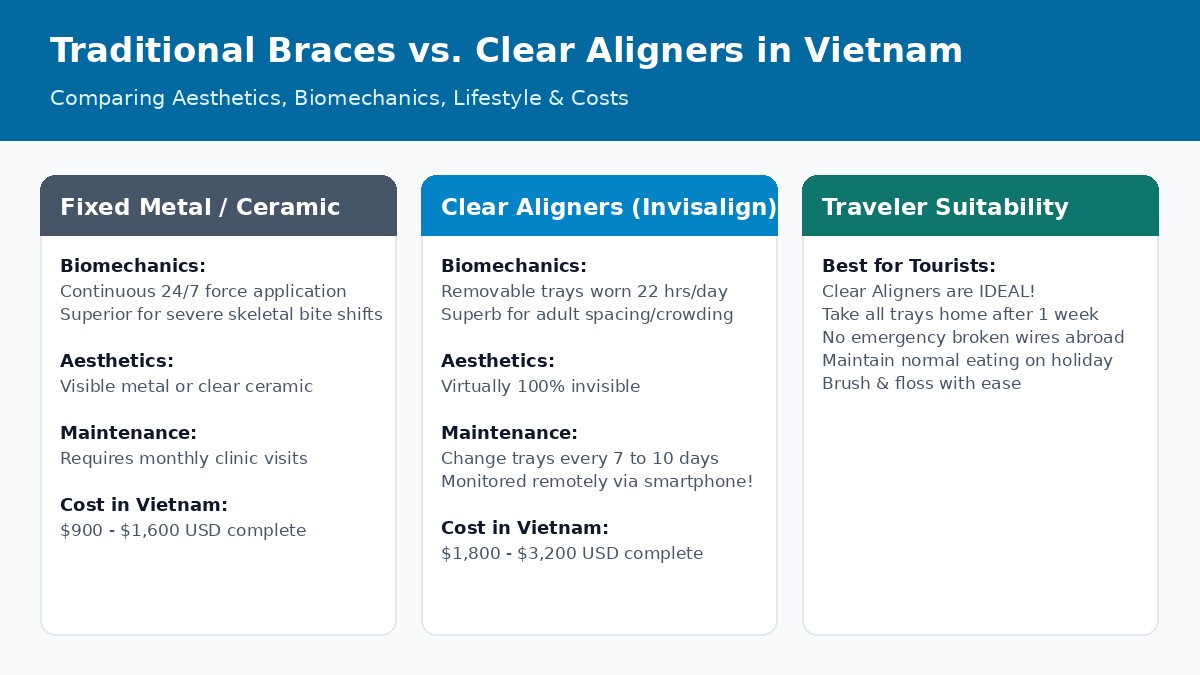
| Clinical Feature | Traditional Fixed Braces | Clear Aligners (Invisalign) |
|---|---|---|
| Appliance Type | Bonded brackets & archwires | Removable clear polymer trays |
| Force Application | Continuous (24 hours/day) | Intermittent (20–22 hrs/day) |
| Complex Movements | Unmatched for severe rotations & high-angle skeletal pulls | Exceptional for arch expansion & tipping; uses attachments |
| Aesthetic Impact | Noticeable metal or ceramic | Virtually 100% invisible |
| Oral Hygiene | Complex; requires floss thread & interdental brushes | Effortless; remove trays to brush and floss normally |
| Dietary Freedom | Restricted (No hard, sticky) | Completely unrestricted |
| Traveler Friendly | Requires monthly adjustments | IDEAL: remote app monitoring |
The Biomechanics of Fixed Braces
Braces consist of metal (stainless steel or titanium) or clear ceramic brackets bonded to the facial surface of each tooth. A shape-memory nickel-titanium archwire runs through the bracket slots, applying continuous 24/7 multi-directional force vectors. Because braces cannot be removed by the patient, compliance is 100% guaranteed.
The Biomechanics of Clear Aligners
Clear aligner systems utilize a sequence of 3D-printed thermoplastic trays. Each individual tray is engineered to move specific teeth by 0.2mm to 0.25mm. Small, tooth-colored composite bumps (SmartForce® attachments) are temporarily bonded to certain teeth to act as handles, allowing the plastic aligner to push, rotate, or intrude roots with high precision.
2. Cost Analysis: Vietnam vs Australia & United States
In Western healthcare markets, specialist orthodontic fees are notoriously steep. In Vietnam, international patients enjoy world-class care at transparent, inclusive rates:
To review general pricing across all specialties, consult: Dental Tourism Vietnam Cost: Complete Price Guide 2025 and view our Invisalign Cost in Vietnam vs Australia/US.
| Orthodontic Treatment System | Australia (AUD $) | Vietnam Certified |
|---|---|---|
| Traditional Metal Braces (3M/Ormco) (Complete 18-24 month case) | $6,000 – $8,500 AUD ($4,000 – $5,700 USD) | $1,350 – $2,100 AUD ($900 – $1,400 USD) |
| Ceramic Clear Braces (Clarity Adv) (Aesthetic ceramic brackets) | $7,000 – $9,500 AUD ($4,700 – $6,400 USD) | $1,800 – $2,700 AUD ($1,200 – $1,800 USD) |
| Damon Self-Ligating Braces (Low-friction passive slide doors) | $7,500 – $10,000 AUD ($5,000 – $6,700 USD) | $2,100 – $3,000 AUD ($1,400 – $2,000 USD) |
| Invisalign Comprehensive (Full arch clear aligner system) | $8,500 – $11,500 AUD ($5,700 – $7,700 USD) | $3,300 – $4,800 AUD ($2,200 – $3,200 USD) |

<!-- IMAGE SUGGESTION 2 (mid-article): Mid-article: orthodontist reviewing ClinCheck 3D simulation with patient -->
3. Which Option Is Best for International Patients?
When evaluating orthodontic therapy from abroad, travel logistics are paramount:
- Why Clear Aligners Are Ideal for Tourists:
- Single Setup Trip: All diagnostic scanning, digital ClinCheck planning, attachment bonding, and aligner dispensation can be completed in a single 7-day visit to Da Nang.
- Take Everything Home: You return home with your entire treatment box (e.g., Trays #1 through #30).
- Zero Emergency Wire Visits: No sharp archwires or loose brackets to cause painful emergencies in your home country.
- Remote Monitoring: You submit weekly smartphone scans to your Vietnamese orthodontist, who monitors root movement digitally.
- When Fixed Braces Are Feasible:
- Expatriates residing in Vietnam.
- Digital nomads spending 6 to 12 months in Da Nang or Ho Chi Minh City.
- Frequent travelers who visit Vietnam every 6 to 8 weeks for business or family.
To learn about treatment duration, read: How Long Does Orthodontic Treatment Take in Vietnam?.
4. Adult Lifestyle Considerations
Straightening teeth as an adult involves professional and social considerations:
1. Professional Workplace Confidence: Clear aligners are virtually invisible in boardrooms, client presentations, and social dinners. Ceramic braces offer a discreet fixed alternative.
2. Dining on Vacation: With clear aligners, you simply pop the trays out before dining on crisp Vietnamese baguettes (bánh mì), grilled local seafood, or fresh tropical fruit. With fixed braces, hard and sticky foods must be strictly avoided to prevent sheared brackets.
3. Flossing and Gum Health: Maintaining healthy gums is effortless with aligners. With braces, meticulous flossing requires specialized threaders, increasing the risk of gingivitis if neglected.
To explore adult orthodontics, read: Adult Orthodontics in Vietnam: Is It Too Late? and check clinic directories on Da Nang Dental Hub.
Practical tip: If you are starting clear aligners, bring a small case and cleaning crystals in your day bag. You will be removing trays for meals constantly, and having the kit with you keeps the routine effortless.
<!-- IMAGE SUGGESTION 3 (before FAQ): Before FAQ: straight confident smile after orthodontic treatment -->
Frequently Asked Questions (FAQ)
What is the primary clinical difference between braces and clear aligners?
Traditional braces utilize metal or ceramic brackets bonded directly to teeth, connected by flexible archwires that apply continuous 24/7 traction force. Clear aligners (like Invisalign) use a series of custom-milled, removable clear plastic trays that apply targeted incremental pressure. Braces excel at complex skeletal movements and severe root torque, while clear aligners offer superior aesthetics, effortless oral hygiene, and complete dietary freedom.
Why are clear aligners better suited for dental tourists than fixed braces?
Fixed braces require hands-on clinical adjustments every 4 to 6 weeks to change archwires and power chains, making them impractical for overseas travelers unless they visit Vietnam regularly. Clear aligners, by contrast, allow patients to receive their full series of trays during an initial 7-day visit. Ongoing treatment progress is monitored remotely via smartphone tele-orthodontic apps.
How much cheaper are braces and aligners in Vietnam compared to Australia or the US?
In Australia, traditional metal braces cost $6,000 to $8,500 AUD, and Invisalign costs $7,500 to $10,500 AUD. In Vietnam, high-quality 3M or Damon metal braces cost $900 to $1,400 USD ($1,350 to $2,100 AUD), ceramic clear braces cost $1,200 to $1,800 USD ($1,800 to $2,700 AUD), and genuine Invisalign costs $2,200 to $3,200 USD ($3,300 to $4,800 AUD)—saving patients 60% to 75%.
Do clear aligners take longer to straighten teeth than traditional braces?
For mild to moderate crowding or spacing, clear aligners often complete treatment faster (typically 6 to 12 months) than traditional braces because computer algorithms move multiple teeth simultaneously. However, clear aligners require strict patient compliance: trays must be worn 20 to 22 hours per day. For severe complex skeletal bites, fixed braces remain slightly more efficient.
How are braces adjustments handled if I live abroad?
If you get braces in Vietnam but live elsewhere, any licensed orthodontist at home can perform routine adjustments — bracket systems are standardized worldwide. Many patients instead choose clear aligners, which need fewer in-person visits.
How does Vietnam compare to Thailand for dental tourism?
Both offer quality care, but Vietnam is typically 20–30% cheaper than Thailand for equivalent treatments, with newer clinic infrastructure in Da Nang. Thailand has a longer track record, while Vietnam offers a quieter, less touristy recovery setting.
Choose Your Ideal Orthodontic Path in Vietnam
Whether you prefer the uncompromised biomechanics of fixed Damon braces or the invisible freedom of Invisalign clear aligners, Vietnam delivers world-class orthodontic expertise at remarkable savings.
---
This article is for informational purposes only and is not medical advice. Please consult a qualified dentist for diagnosis and treatment options.
What is the primary clinical difference between braces and clear aligners?
Traditional braces utilize metal or ceramic brackets bonded directly to teeth, connected by flexible archwires that apply continuous 24/7 traction force. Clear aligners (like Invisalign) use a series of custom-milled, removable clear plastic trays that apply targeted incremental pressure. Braces excel at complex skeletal movements and severe root torque, while clear aligners offer superior aesthetics, effortless oral hygiene, and complete dietary freedom.
Why are clear aligners better suited for dental tourists than fixed braces?
Fixed braces require hands-on clinical adjustments every 4 to 6 weeks to change archwires and power chains, making them impractical for overseas travelers unless they visit Vietnam regularly. Clear aligners, by contrast, allow patients to receive their full series of trays during an initial 7-day visit. Ongoing treatment progress is monitored remotely via smartphone tele-orthodontic apps.
How much cheaper are braces and aligners in Vietnam compared to Australia or the US?
In Australia, traditional metal braces cost $6,000 to $8,500 AUD, and Invisalign costs $7,500 to $10,500 AUD. In Vietnam, high-quality 3M or Damon metal braces cost $900 to $1,400 USD ($1,350 to $2,100 AUD), ceramic clear braces cost $1,200 to $1,800 USD ($1,800 to $2,700 AUD), and genuine Invisalign costs $2,200 to $3,200 USD ($3,300 to $4,800 AUD)—saving patients 60% to 75%.
Do clear aligners take longer to straighten teeth than traditional braces?
For mild to moderate crowding or spacing, clear aligners often complete treatment faster (typically 6 to 12 months) than traditional braces because computer algorithms move multiple teeth simultaneously. However, clear aligners require strict patient compliance: trays must be worn 20 to 22 hours per day. For severe complex skeletal bites, fixed braces remain slightly more efficient.
How are braces adjustments handled if I live abroad?
If you get braces in Vietnam but live elsewhere, any licensed orthodontist at home can perform routine adjustments — bracket systems are standardized worldwide. Many patients instead choose clear aligners, which need fewer in-person visits.
How does Vietnam compare to Thailand for dental tourism?
Both offer quality care, but Vietnam is typically 20–30% cheaper than Thailand for equivalent treatments, with newer clinic infrastructure in Da Nang. Thailand has a longer track record, while Vietnam offers a quieter, less touristy recovery setting.
Dental Tourism Vietnam Cost: Complete Price Guide & Financial Planning 2026
Save 70-80% on dental care in Vietnam. Complete 2025 cost guide, procedure comparison vs Australia/US/UK, payment methods, hidden fees & net ROI calculator.
Complete Cost Breakdown: Flight + Hotel + Treatment in Vietnam
Full out-of-pocket cost breakdown for dental tourism in Vietnam. Return flights, 4-star hotels, dental procedures, meals, and real patient budget models.
Dental Tourism Cost Calculator: How to Estimate Your Trip
Calculate your dental tourism savings in Vietnam. 4-step formula: clinic procedures + flights + resort stays + living expenses vs Western costs.
Independent Pre-Trip Resources for International Patients
To ensure your dental travel journey is seamless and well-prepared, we recommend consulting these independent destination and recovery travel guides:
"Read the medical travel & e-Visa preparation guide at VietnamMedicalTravelGuide.com"
• Post-op soft food dining & culinary recovery in Vietnam
"Find 5-star beachfront resorts near dental centers at DaNangDentalHub.com"
• Top 5-star beachfront resorts with clinic concierge shuttles