Cavity Treatment in Vietnam: When You Need It
Understand tooth cavity stages and restorative treatments in Vietnam. Biomimetic fillings, pulp capping, minimally invasive dentistry, and costs in Da Nang.
By Đội ngũ DentalTreatmentVietnam · Medically reviewed by a licensed dental surgeon · Last updated: October 12, 2026
A note on prices: All prices in this article are shown as indicative ranges (not fixed quotes) and were last reviewed in October 2026. Your clinic will confirm an exact written quote before treatment begins.

A cavity caught early is a 30-minute fix; caught late, it becomes a root canal. Here is how to tell where you stand — and what a filling fairly costs in Vietnam.
Dental cavities rarely announce themselves with dramatic pain in their early stages. Instead, tooth decay develops silently: bacteria in dental plaque ferment dietary sugars into lactic acid, quietly leaching calcium and phosphate minerals from the microscopic crystal matrix of your tooth enamel.
By the time you feel that sharp twinge when drinking an iced coffee or eating fresh pineapple on a tropical beach in Vietnam, the decay has already punched through outer enamel and invaded the living, porous dentin beneath.
Understanding when and how to treat tooth decay is essential to preserving your natural dentition. In modern clinical practice across Vietnam, dentists practice Minimally Invasive Dentistry—conserving healthy enamel, utilizing bio-active remineralizing liners, and placing invisible, long-lasting composite restorations at a fraction of Western costs.

1. The 4 Stages of Tooth Decay & Clinical Solutions
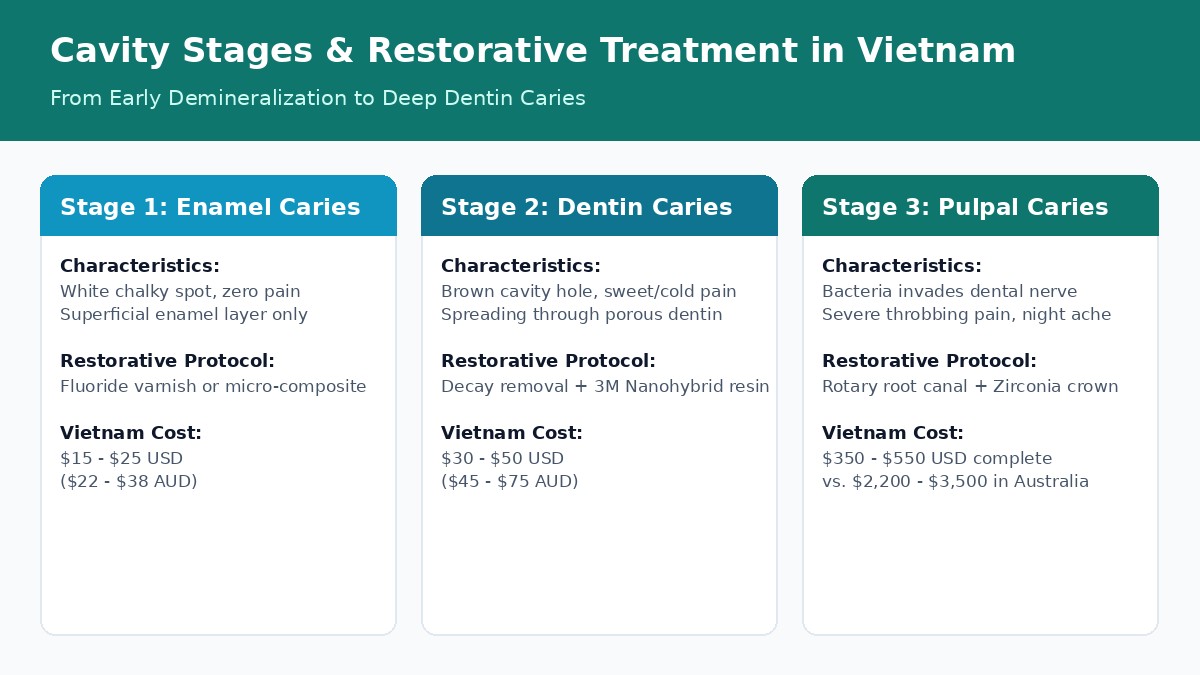
Tooth decay follows a predictable pathological progression. Catching decay early dramatically reduces treatment complexity and cost:
THE 4 STAGES OF DENTAL DECAY
To review the restorative materials used for fillings, read: Dental Fillings in Vietnam: Composite vs Amalgam Cost Guide and learn about endodontics in Root Canal Treatment Cost in Vietnam vs Australia/US/UK.
| Decay Stage | Anatomical Depth | Typical Symptoms | Clinical Action |
|---|---|---|---|
| Stage 1: Enamel Demineralization | Superficial enamel layer only | Completely painless; white chalky spot | Fluoride therapy or icon resin infiltration |
| Stage 2: Dentin Caries | Penetrates through enamel into porous dentinal tubules | Sensitivity to sweets, cold & food trapping | Gentle removal; 3M nanohybrid composite resin |
| Stage 3: Deep Pulp Infection (Pulpitis) | Bacteria invade living nerve & blood vessel core | Spontaneous sharp throbbing pain; pain at night | Rotary root canal therapy + Zirconia crown |
| Stage 4: Periapical Abscess | Infection spreads into jawbone past root apex | Severe swelling, pus discharge, fever, loose tooth | Drainage, root canal or gentle extraction |
2. Cost Analysis: Treating Cavities Early vs Waiting
Delaying cavity treatment is one of the costliest financial mistakes in healthcare. What starts as an affordable minor filling quickly balloons into complex multi-stage surgery:
To review complete procedure pricing, consult: Dental Tourism Vietnam Cost: Complete Price Guide 2025 and view our full range of services in General Dentistry in Vietnam: Root Canal, Fillings & Extractions Guide.
| Stage of Intervention | Australia (AUD $) | Vietnam Certified |
|---|---|---|
| Early Stage 2: Composite Filling (1-2 surface tooth restoration) | $200 – $350 AUD ($140 – $240 USD) | $38 – $75 AUD ($25 – $50 USD) |
| Late Stage 2: Ceramic Inlay/Onlay (Extensive cusp rebuild via CAD) | $950 – $1,600 AUD ($650 – $1,100 USD) | $270 – $390 AUD ($180 – $260 USD) |
| Stage 3: Root Canal + Crown (Endodontics + Zirconia Crown) | $3,200 – $5,000 AUD ($2,150 – $3,400 USD) | $525 – $850 AUD ($350 – $570 USD) |
| Stage 4: Extraction + Implant (Implant fixture, abutment, crown) | $5,500 – $7,500 AUD ($3,700 – $5,000 USD) | $1,300 – $2,000 AUD ($850 – $1,300 USD) |
3. Minimally Invasive Dentistry: How Vietnam Preserves Teeth
Accredited dental centers in Da Nang utilize modern biomimetic principles that prioritize tooth conservation:

- Caries Indicator Dyes: A specialized glycol-based dye stains only infected, irreversibly denatured collagen fibers bright red. The dentist selectively removes the stained layer, preserving healthy remineralizable dentin.
- Bio-Active Pulp Capping (TheraCal LC / MTA): When decay approaches within 0.5mm of the dental nerve, rather than rushing into a root canal, the dentist applies a layer of bio-active mineral trioxide aggregate (MTA). This stimulates the tooth to deposit a protective layer of natural reparative secondary dentin, saving the nerve!
- Nanohybrid Sculpting: Using top-tier American (3M Filtek Supreme) or Japanese (Tokuyama Estelite) resins, the dentist stratifies enamel and dentin shades, recreating natural occlusal grooves and anatomy.
To see what happens if tooth extraction is required, read: Tooth Extraction in Vietnam: Cost, Process & Recovery.
4. When Should You Book an Appointment in Da Nang?
If you are planning a trip to Vietnam, adding a comprehensive dental exam and cleaning to your itinerary is simple:
- Duration: An exam, digital bitewing X-rays, and 2 to 4 composite fillings take just 60 to 90 minutes.
- Zero Downtime: Because composite resin is light-cured with high-intensity LED light, it achieves 100% cure strength instantly. You can dine on delicious Vietnamese street food as soon as your local numbness fades.
To check clinic reviews and technology in Central Vietnam, review: Da Nang Dental Hub.
Practical tip: Ask whether the quote covers composite (tooth-colored) or amalgam, and how many tooth surfaces are involved. A cheap-looking quote sometimes assumes the smallest possible case.

Frequently Asked Questions (FAQ)
How do I know if I have a dental cavity before it starts hurting?
In early stages, tooth decay is completely painless. Warning signs include: (1) A visible white chalky spot or dark brown pit on your tooth surface, (2) Food consistently getting trapped between the same two teeth, (3) Brief sensitivity to sweet foods, cold beverages, or iced water, and (4) Roughness felt with your tongue. Digital bitewing X-rays taken during a routine checkup reveal hidden interdental cavities long before they cause physical discomfort.
What happens if I delay treating a cavity while traveling in Vietnam?
Tooth decay never heals on its own. It steadily advances from outer enamel into porous dentin, which decays twice as fast. Once bacteria breach the pulp chamber, spontaneous throbbing pain (pulpitis) develops, converting a simple 20-minute, $24–$37 USD composite filling into a multi-session root canal and crown costing $350 to $550 USD.
What is minimally invasive cavity treatment in modern Vietnamese clinics?
Minimally invasive dentistry uses caries-detector dyes, micro-diamond burs, and dental loupes to selectively remove only infected, non-remineralizable tooth collagen. Healthy, uninfected dentin is preserved intact, and bio-active calcium silicate liners (such as TheraCal LC or MTA) are applied to stimulate biological healing and protect the nerve.
How much does cavity treatment cost in Vietnam compared to Australia?
Treating a minor to moderate cavity with high-end nanohybrid composite resin (e.g., 3M Filtek Supreme) in Vietnam costs between $25 and $50 USD ($38 to $75 AUD) per tooth. In Australia, the identical filling costs $200 to $380 AUD ($140 to $260 USD), providing immediate savings of 80%.
How do I know if my cavity needs a filling or a crown?
It depends on how much healthy tooth is left. Small to medium cavities get fillings; large ones — or teeth that already had root canals — usually need crowns for strength. Your dentist decides from the X-ray, so ask to see it.
Do white fillings last as long as silver ones?
Modern composite fillings last many years with good care, though amalgam holds a slight edge in raw durability for back teeth. Most international clinics now work almost exclusively with tooth-colored materials.

Stop Cavities in Their Tracks: Book in Vietnam Today
Protect your smile from expensive complications. Experience gentle, minimally invasive cavity treatment in Da Nang using world-class materials and advanced digital diagnostics.
---
This article is for informational purposes only and is not medical advice. Please consult a qualified dentist for diagnosis and treatment options.
How do I know if I have a dental cavity before it starts hurting?
In early stages, tooth decay is completely painless. Warning signs include: (1) A visible white chalky spot or dark brown pit on your tooth surface, (2) Food consistently getting trapped between the same two teeth, (3) Brief sensitivity to sweet foods, cold beverages, or iced water, and (4) Roughness felt with your tongue. Digital bitewing X-rays taken during a routine checkup reveal hidden interdental cavities long before they cause physical discomfort.
What happens if I delay treating a cavity while traveling in Vietnam?
Tooth decay never heals on its own. It steadily advances from outer enamel into porous dentin, which decays twice as fast. Once bacteria breach the pulp chamber, spontaneous throbbing pain (pulpitis) develops, converting a simple 20-minute, $24–$37 USD composite filling into a multi-session root canal and crown costing $350 to $550 USD.
What is minimally invasive cavity treatment in modern Vietnamese clinics?
Minimally invasive dentistry uses caries-detector dyes, micro-diamond burs, and dental loupes to selectively remove only infected, non-remineralizable tooth collagen. Healthy, uninfected dentin is preserved intact, and bio-active calcium silicate liners (such as TheraCal LC or MTA) are applied to stimulate biological healing and protect the nerve.
How much does cavity treatment cost in Vietnam compared to Australia?
Treating a minor to moderate cavity with high-end nanohybrid composite resin (e.g., 3M Filtek Supreme) in Vietnam costs between $25 and $50 USD ($38 to $75 AUD) per tooth. In Australia, the identical filling costs $200 to $380 AUD ($140 to $260 USD), providing immediate savings of 80%.
How do I know if my cavity needs a filling or a crown?
It depends on how much healthy tooth is left. Small to medium cavities get fillings; large ones — or teeth that already had root canals — usually need crowns for strength. Your dentist decides from the X-ray, so ask to see it.
Do white fillings last as long as silver ones?
Modern composite fillings last many years with good care, though amalgam holds a slight edge in raw durability for back teeth. Most international clinics now work almost exclusively with tooth-colored materials.
Dental Tourism Vietnam Cost: Complete Price Guide & Financial Planning 2026
Save 70-80% on dental care in Vietnam. Complete 2025 cost guide, procedure comparison vs Australia/US/UK, payment methods, hidden fees & net ROI calculator.
Complete Cost Breakdown: Flight + Hotel + Treatment in Vietnam
Full out-of-pocket cost breakdown for dental tourism in Vietnam. Return flights, 4-star hotels, dental procedures, meals, and real patient budget models.
Dental Tourism Cost Calculator: How to Estimate Your Trip
Calculate your dental tourism savings in Vietnam. 4-step formula: clinic procedures + flights + resort stays + living expenses vs Western costs.
Independent Pre-Trip Resources for International Patients
To ensure your dental travel journey is seamless and well-prepared, we recommend consulting these independent destination and recovery travel guides:
"Read the medical travel & e-Visa preparation guide at VietnamMedicalTravelGuide.com"
• Post-op soft food dining & culinary recovery in Vietnam
"Find 5-star beachfront resorts near dental centers at DaNangDentalHub.com"
• Top 5-star beachfront resorts with clinic concierge shuttles