Dental Implant Recovery Timeline: Day 1 to Day 90
Detailed dental implant healing timeline from Day 1 to Day 90. Learn when swelling peaks, pain stops, bone osseointegrates, and crowns are placed.
By Đội ngũ DentalTreatmentVietnam · Medically reviewed by a licensed dental surgeon · Last updated: October 12, 2026

Healing is where patience pays off. Here is what your mouth is actually doing in the weeks after implant surgery — and how to help it along instead of getting in the way.
Undergoing dental implant surgery is a major milestone toward reclaiming your chewing power, dental health, and confident smile. While modern digital surgical techniques have transformed implant placement into a minimally invasive, virtually painless procedure, the biological process of healing takes time.
Your body must perform two distinct restorative miracles: first, repairing the delicate oral mucosal tissues and gingival margins around the post; second, undergoing osseointegration—the complex cellular process where living jawbone permanently fuses with the titanium implant fixture.
For international patients receiving dental implants in Vietnam, understanding what to expect day by day and month by month transforms recovery from an anxious waiting game into a predictable, relaxing healing vacation.

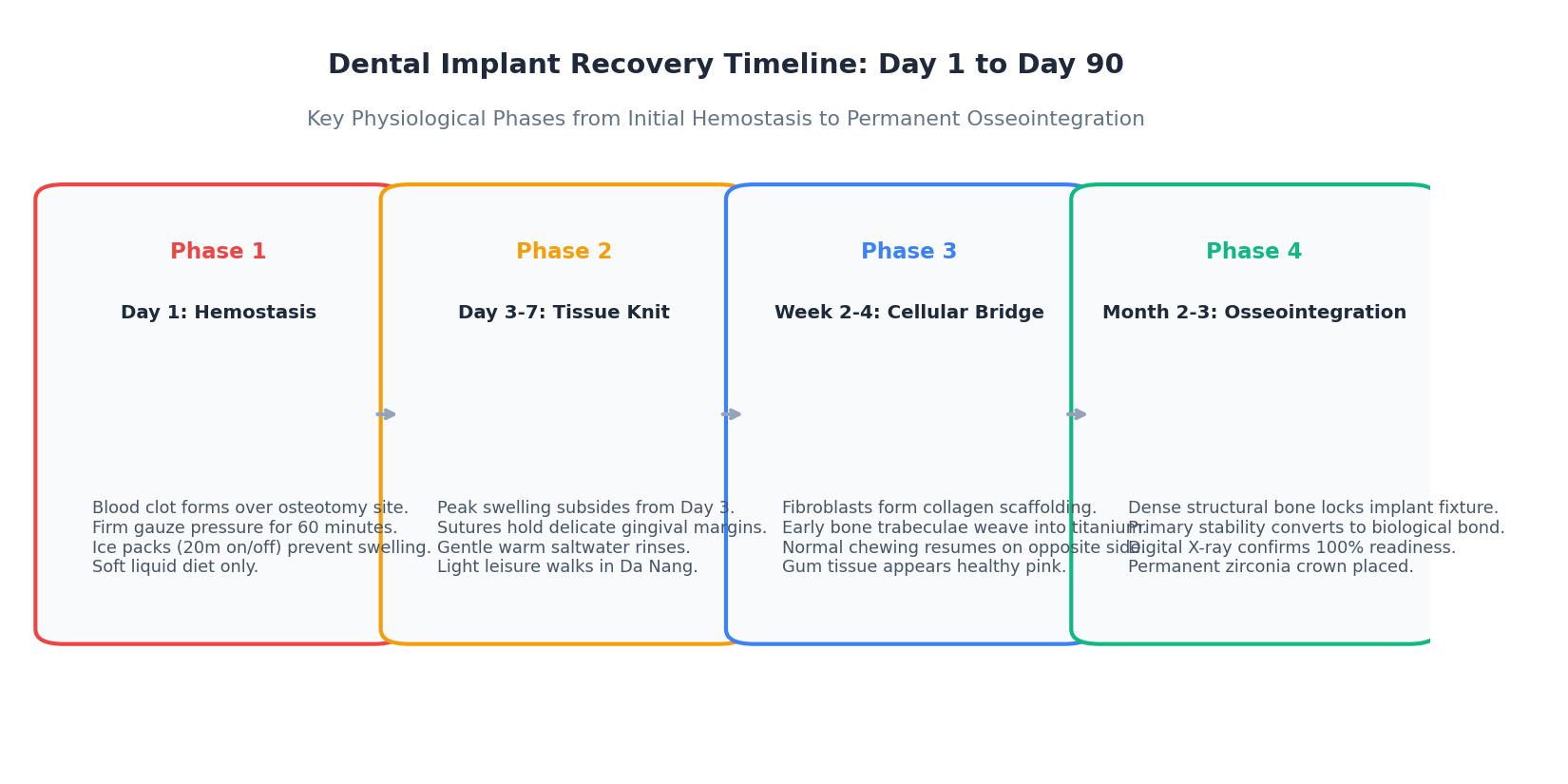
1. Phase 1: Days 1 to 3 — Hemostasis, Clot Formation & Peak Edema
The first 72 hours represent the acute surgical response phase. During this window, your primary objective is protecting the fragile initial blood clot and managing localized tissue inflammation.
CRITICAL MILESTONES: DAYS 1 TO 3
| Timeframe | Biological Event | Actionable Care Steps |
|---|---|---|
| Hours 0–4 | Anesthesia wears off; capillary hemostasis begins | - Take prescribed pain relief - Bite firmly on gauze 60 min - Zero spitting, zero straws |
| Hours 4–24 (Day 1) | Fibrin mesh stabilizes; oozing subsides | - Apply ice packs 20m on/off - Keep head elevated on bed - Pureed, lukewarm liquids |
| Days 2–3 (Peak Swelling) | Inflammatory edema peaks; mild muscular jaw stiffness (trismus) | - Switch to warm compresses - Gentle warm salt-water rinse - Continue antibiotic course |
Day 1: Protecting the Blood Clot
When local anesthesia subsides 2 to 4 hours after your procedure, mild dull aching is typical.
- Sterile Gauze Pressure: Bite down firmly on the sterile gauze pack placed over the implant site for 45 to 60 minutes.
- The Golden Rules of Clot Preservation: Never spit vigorously, suck through a straw, or smoke. Negative intraoral pressure will dislodge the fibrin clot, triggering bleeding and exposing bone to bacterial contamination.
- Cold Therapy: Apply a cold ice pack to your cheek for 20 minutes on, 20 minutes off to constrict blood vessels and limit post-operative bruising.
Days 2 to 3: Managing Peak Swelling
Facial puffiness normally increases on Day 2 and peaks on Day 3. This swelling is a natural immunological response bringing white blood cells to repair the area.
- Switch to Moist Heat: After 48 hours, replace cold packs with warm, moist towels to stimulate circulation and relieve jaw tightness.
- Warm Saline Rinses: 24 hours after surgery, begin gentle warm saltwater rinses (1/2 teaspoon salt in warm water) after meals. Do not swish violently; gently roll the water in your mouth and let it spill into the basin.
To review dietary recommendations during this phase, read: What is a Dental Implant? Complete Beginner's Guide.
2. Phase 2: Days 4 to 14 — Soft Tissue Healing & Suture Removal
Between Day 4 and Day 14, the acute inflammatory response resolves, and active fibroblastic repair takes over.
[ Day 4–7: Granulation Tissue Fills Wound Margins ]
[ Day 7–10: Clinical In-Clinic Evaluation & Suture Removal ]
[ Day 10–14: Epithelial Seal Closes Around Healing Abutment ]
Days 4 to 7: Noticeable Relief & Sightseeing
By Day 4, facial swelling noticeably subsides, and pain becomes minimal. Most international travelers feel energetic enough to explore Central Vietnam's serene sights:
- Stroll the shaded pedestrian pathways of Hoi An Ancient Town.
- Enjoy low-intensity walks along the palm-fringed promenades of My Khe Beach.
- Transition from pureed liquids to soft, comforting solid foods (steamed fish, soft scrambled eggs, and silken tofu).

Days 7 to 10: Suture Removal & Flight Clearance
If non-resorbable silk or nylon sutures were placed, you will return to the clinic around Day 7:
- The surgeon gently removes sutures in under 5 minutes without pain.
- Gingival margins around the healing abutment or provisional crown are evaluated for healthy pink coloration and firm tone.
- Digital X-rays verify fixture position.
- You receive your written Fit-to-Fly Medical Certificate, confirming it is safe to board commercial flights home.
For flight safety rules, read: Post-Treatment Recovery Care: Complete Guide.
3. Phase 3: Weeks 3 to 8 — The Cellular Bridge of Osseointegration
While you feel completely back to normal on the surface, a complex microscopic transformation is occurring deep within your jawbone.
The Biology of Osseointegration
Between Weeks 3 and 8, the mechanical "primary stability" achieved by the surgical screw threads gradually gives way to biological "secondary stability":
1. Osteoblast Recruitment: Bone-forming cells colonize the microscopic titanium SLA (sandblasted, large-grit, acid-etched) porous surface.
2. Woven Bone Formation: Immature woven bone weaves into the microscopic valleys of the titanium post.
3. Lamellar Bone Remodeling: Woven bone matures into dense, load-bearing lamellar bone, permanently locking the implant fixture into your skeleton.
Guidelines for Home Life
- Chewing Caution: Chew on the opposite side of your mouth. Never chew hard candies, nuts, or tough crusts directly over the healing implant.
- Oral Hygiene: Maintain immaculate plaque control using an ultra-soft surgical toothbrush and alcohol-free chlorhexidine mouthwash as prescribed.
4. Phase 4: Days 60 to 90 — Final Crown Loading & Lifetime Function
By Day 60 to 90 (2 to 3 months post-surgery), osseointegration is complete. In cases involving major sinus lifts or extensive bone grafting, clinicians may extend this phase to 4 to 6 months to ensure absolute skeletal density.
FINAL RESTORATIVE APPOINTMENT PROTOCOL
| Clinical Action | Technology Employed | Patient Outcome |
|---|---|---|
| Osseointegration Verification | Digital OPG / Periapical X-ray + Resonance Check | Verifies dense bone contact with zero radiolucency |
| Optical 3D Digital Impression | iTero 5D / 3Shape Intraoral Scanner | Captures microscopic gingival emergence profile |
| Permanent Crown Milling & Glazing | 5-Axis In-House CAD/CAM Milling Unit | Solid monolithic zirconia custom-shaded to smile |
| Final Torque & Bite Calibration | Calibrated Mechanical Torque Wrench | 35 Ncm torque fixation; 100% natural chewing power |
Placing the Permanent Zirconia Crown
1. Your healing cap or temporary crown is removed.
2. An intraoral digital scanner captures the sub-millimeter position of the implant fixture.
3. Within 24 to 48 hours, master ceramists mill your permanent solid zirconia or IPS e.max crown.
4. The crown is securely fastened to the titanium abutment using a calibrated torque wrench (35 Ncm) and permanently sealed.
5. Your bite is calibrated with articulating film to ensure zero premature contact during chewing.
To compare procedural costs across nations, read: [Dental Implants Cost: Vietnam vs. Australia vs. USA [2025]](https://dentaltreatmentvietnam.com/services/dental-implants/implant-cost-vietnam-vs-australia).
5. Warning Signs: When to Contact Your Dentist
While dental implant surgery boasts an extraordinary global success rate exceeding 98%, international patients should monitor for abnormal complications:
- Persistent Bleeding: Bright red blood that saturates gauze pads after 4 hours of continuous pressure.
- Worsening Pain or Swelling: Discomfort or facial swelling that intensifies after Day 4 rather than improving.
- Fever & Purulent Discharge: Body temperature exceeding 38.5°C (101.3°F) accompanied by a foul taste or pus along the gumline.
- Fixture Mobility: Any noticeable movement of the implant post or healing abutment.
Accredited Vietnamese clinics provide continuous 24/7 patient concierge access via WhatsApp for instant digital triage.
Practical tip: The boring instructions matter most: no smoking, no drinking through straws, no hard chewing on the implant side. Most complications trace back to skipping the simple stuff.

Frequently Asked Questions (FAQ)
How long does it take for a dental implant to fully heal and integrate with bone?
Initial soft tissue gum healing occurs within 7 to 14 days, during which sutures are removed. Full biological osseointegration—where the living alveolar bone permanently fuses with the microscopic porous titanium surface—typically takes 8 to 12 weeks (60 to 90 days) before the final permanent zirconia crown can be safely loaded.
What is the most painful day after dental implant surgery?
Most patients experience the peak of post-operative soreness and facial swelling between 48 and 72 hours (Day 2 and Day 3). After Day 3, discomfort diminishes significantly each day. By Day 5 to 7, most patients no longer require prescription analgesics.
Can I return to work or explore Da Nang during my dental implant recovery?
Yes. Patients can resume light, sedentary daily activities, remote laptop work, and leisurely sightseeing (such as strolling along My Khe Beach or visiting Hoi An) within 24 to 48 hours post-surgery. Strenuous cardiovascular workouts, gym lifting, and ocean swimming must be postponed for 7 to 10 days.
What should I do if my implant site feels sore or throbs after 2 weeks?
Mild sensitivity when pressing the cheek is normal in early weeks. However, if sharp throbbing pain, worsening swelling, or an unpleasant taste develops after Week 2, contact your dental clinic immediately for a digital follow-up, as this may indicate localized inflammation requiring antibiotic irrigation.
When can I return to work after implant surgery?
Most people return to desk work within 1–2 days. If your job is physical, allow 3–5 days. Plan around peak swelling (day 2–3) rather than the surgery day itself.
What are warning signs that healing is not going well?
Worsening pain after day 3–4, persistent bleeding, foul taste or odor, fever, or an implant that feels loose. Any of these warrants a prompt call to your dentist — do not wait for your scheduled check-up.

Heal in Comfort with World-Class Care in Vietnam
Recovering from dental implant surgery in Vietnam combines cutting-edge surgical precision with the rejuvenating ambiance of a tranquil coastal holiday. Experience gentle care, transparent recovery support, and unmatched affordability.
---
This article is for informational purposes only and is not medical advice. Please consult a qualified dentist for diagnosis and treatment options.
How long does it take for a dental implant to fully heal and integrate with bone?
Initial soft tissue gum healing occurs within 7 to 14 days, during which sutures are removed. Full biological osseointegration—where the living alveolar bone permanently fuses with the microscopic porous titanium surface—typically takes 8 to 12 weeks (60 to 90 days) before the final permanent zirconia crown can be safely loaded.
What is the most painful day after dental implant surgery?
Most patients experience the peak of post-operative soreness and facial swelling between 48 and 72 hours (Day 2 and Day 3). After Day 3, discomfort diminishes significantly each day. By Day 5 to 7, most patients no longer require prescription analgesics.
Can I return to work or explore Da Nang during my dental implant recovery?
Yes. Patients can resume light, sedentary daily activities, remote laptop work, and leisurely sightseeing (such as strolling along My Khe Beach or visiting Hoi An) within 24 to 48 hours post-surgery. Strenuous cardiovascular workouts, gym lifting, and ocean swimming must be postponed for 7 to 10 days.
What should I do if my implant site feels sore or throbs after 2 weeks?
Mild sensitivity when pressing the cheek is normal in early weeks. However, if sharp throbbing pain, worsening swelling, or an unpleasant taste develops after Week 2, contact your dental clinic immediately for a digital follow-up, as this may indicate localized inflammation requiring antibiotic irrigation.
When can I return to work after implant surgery?
Most people return to desk work within 1–2 days. If your job is physical, allow 3–5 days. Plan around peak swelling (day 2–3) rather than the surgery day itself.
What are warning signs that healing is not going well?
Worsening pain after day 3–4, persistent bleeding, foul taste or odor, fever, or an implant that feels loose. Any of these warrants a prompt call to your dentist — do not wait for your scheduled check-up.
Dental Tourism Vietnam Cost: Complete Price Guide & Financial Planning 2026
Save 70-80% on dental care in Vietnam. Complete 2025 cost guide, procedure comparison vs Australia/US/UK, payment methods, hidden fees & net ROI calculator.
Complete Cost Breakdown: Flight + Hotel + Treatment in Vietnam
Full out-of-pocket cost breakdown for dental tourism in Vietnam. Return flights, 4-star hotels, dental procedures, meals, and real patient budget models.
Dental Tourism Cost Calculator: How to Estimate Your Trip
Calculate your dental tourism savings in Vietnam. 4-step formula: clinic procedures + flights + resort stays + living expenses vs Western costs.
Independent Pre-Trip Resources for International Patients
To ensure your dental travel journey is seamless and well-prepared, we recommend consulting these independent destination and recovery travel guides:
"Check international dental travel insurance rules on VietnamMedicalTravelGuide"
• Post-op soft food dining & culinary recovery in Vietnam
"Explore the Da Nang expat enclave & coastal guide on DaNangDentalHub"
• Top 5-star beachfront resorts with clinic concierge shuttles