Remote Monitoring for Orthodontic Patients After Returning Home
Guide to AI remote orthodontic monitoring for medical tourists in Vietnam. Dental Monitoring app, weekly ScanBox check-ins, safety, and doctor communication.
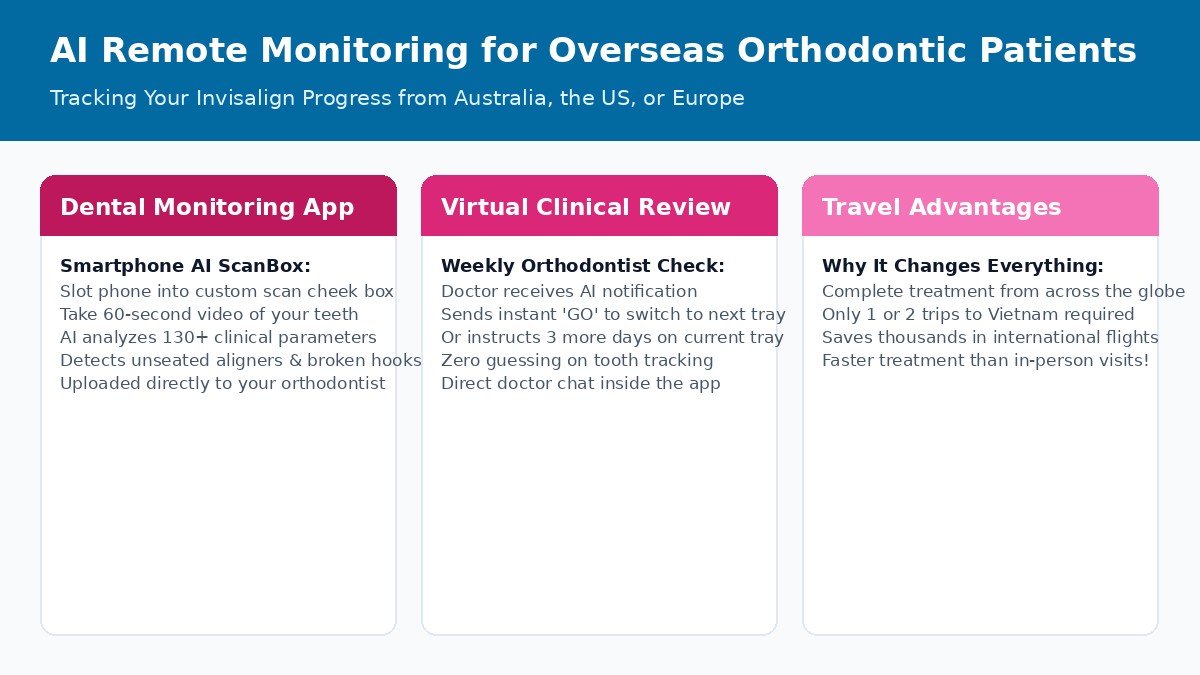
<!-- IMAGE SUGGESTION 1 (hero, right after title): Hero image: clear aligner trays fanned out beside a 3D dental model -->
By Đội ngũ DentalTreatmentVietnam · Medically reviewed by a licensed dental surgeon · Last updated: October 12, 2026
Crooked teeth are not just a cosmetic concern — they trap plaque, wear unevenly, and can strain your jaw for decades. The idea of fixing them as an adult feels daunting enough without a five-figure bill attached. In Vietnam, modern orthodontics costs 60–75% less than in the West, and clear aligner technology means much of the treatment can be monitored remotely. Here is how it works for international patients.
A note on prices: All prices in this article are shown as indicative ranges (not fixed quotes) and were last reviewed in October 2026. Your clinic will confirm an exact written quote before treatment begins.
Historically, the single greatest barrier preventing international travelers from undergoing orthodontic treatment abroad was the requirement for frequent in-person appointments. While a patient could easily fly to Vietnam for a 7-day dental implant surgery or cosmetic veneer placement, fixed braces required monthly manual adjustments, making overseas orthodontic care impractical for most people.
Today, cutting-edge Artificial Intelligence Remote Monitoring has permanently eliminated this obstacle.
Through advanced smartphone tele-orthodontics (such as Dental Monitoring® and Invisalign Virtual Care), patients can begin clear aligner therapy during a short vacation in Da Nang and complete their entire smile transformation from their living room in Australia, the US, or the UK.
This guide provides a comprehensive overview of remote orthodontic monitoring, detailing the technology, weekly scan workflows, safety guardrails, and clinical oversight that make tele-dentistry seamless and dependable.

1. How AI Remote Orthodontic Monitoring Functions
Remote monitoring is not a generic video call or grainy selfie. It is a highly sophisticated, FDA-cleared and CE-certified medical platform:
THE 4-STEP TELE-ORTHODONTIC FEEDBACK LOOP
| STEP 1: Smartphone Scan (Patient) | Slot phone into custom ScanBox device. Record 60-second guided video of bite. |
|---|---|
| STEP 2: AI Clinical Analysis | Proprietary algorithms measure 130+ anatomical parameters to sub-millimeter precision (aligner fit, gingival health). |
| STEP 3: Doctor Clinical Oversight | Orthodontist in Vietnam reviews data, approves progress, or adjusts instructions |
| STEP 4: App Notification to Patient | Receive immediate green 'GO' to switch trays, or instructions to wear 3 days more |
What the AI Evaluates Every Week
The software analyzes your teeth with clinical precision:
- Aligner Seating Depth: Detects air gaps between the plastic tray and tooth incisal edge larger than 0.25 millimeters.
- Attachment Integrity: Verifies that all tooth-colored composite attachments remain firmly bonded to enamel.
- Gingival & Periodontal Health: Flags any localized gum inflammation, swelling, or tartar accumulation.
- Interproximal Spacing: Tracks closure of gaps and space creation according to your ClinCheck roadmap.
To understand clear aligner packages, read: Invisalign Cost in Vietnam vs Australia/US.
2. Why Remote Monitoring Delivers Superior Clinical Outcomes
Many patients assume that remote tele-dentistry is a compromise compared to visiting a local clinic down the street. In reality, scientific clinical trials demonstrate that AI-monitored aligner patients experience fewer refinements, shorter overall treatment times, and higher compliance:
To learn about treatment timelines, see: How Long Does Orthodontic Treatment Take in Vietnam?.
| Care Feature | Traditional In-Person Visits | AI Remote Tele-Monitoring |
|---|---|---|
| Check-In Frequency | Once every 6 to 8 weeks | Every 7 days (52 times/year!) |
| Tracking Error Detection | Discovered weeks later; requires starting trays over | Discovered within 48 hours; corrected with chewies instantly |
| Doctor Communication | Difficult; wait for appt | Direct in-app messaging 24/7 |
| Patient Travel Time | High; traffic & waiting rooms | 2 minutes from your couch |
| Total Out-of-Pocket Cost | $8,500 – $11,500 AUD in Australia or US | $3,300 – $4,800 AUD in Vietnam (65% savings!) |

3. The 3-Step Journey from Da Nang to Your Living Room
Embarking on a tele-orthodontic treatment plan in Central Vietnam is remarkably streamlined:
Step 1: Vacation Setup in Da Nang (7 to 10 Days)
Enjoy a relaxing tropical holiday along Da Nang's pristine coastline. Your clinic captures an iTero 5D digital scan, approves your 3D ClinCheck video, bonds required SmartForce attachments, and hands you your complete boxed sequence of custom Invisalign aligners. You receive your personal ScanBox hardware and complete a hands-on training session with your clinical coordinator.
Step 2: Global Remote Progression (6 to 14 Months)
Back in Australia, New Zealand, the US, or the UK, you wear your aligners for 22 hours daily. Every Sunday morning, you spend 60 seconds taking your scan. Within hours, your Vietnamese orthodontist verifies that your teeth have tracked perfectly and issues a digital notification to switch to the next tray.
Step 3: Relapse-Proof Retention
Once your teeth reach their final ideal alignment, your clinic dispatches your custom Vivera retainers, locking your new smile into place for life.
To explore retainer care, read: Orthodontic Retainers: Cost and Care in Vietnam.
<!-- IMAGE SUGGESTION 2 (mid-article): Mid-article: orthodontist reviewing ClinCheck 3D simulation with patient -->
4. What Happens If You Need In-Person Clinical Support Abroad?
A common question among overseas patients is: What happens if an attachment falls off while I am back home?
- Standard Orthodontic Prescriptions: Accredited clinics in Vietnam utilize standardized American orthodontic attachments and resin bonding protocols.
- Non-Critical Attachments: In most cases, losing a single passive attachment does not stop tooth movement. Your orthodontist evaluates your weekly scan and determines whether replacement is needed immediately or can wait until your refinement stage.
- Local Network Support: If an attachment or wire ever requires in-person attention, your Vietnamese clinic provides an official clinical referral letter detailing exact tooth numbers and composite shade specifications, allowing any local dentist in your hometown to assist in minutes.
To review clinic credentials, visit: Da Nang Dental Hub.
Practical tip: If you are starting clear aligners, bring a small case and cleaning crystals in your day bag. You will be removing trays for meals constantly, and having the kit with you keeps the routine effortless.
<!-- IMAGE SUGGESTION 3 (before FAQ): Before FAQ: straight confident smile after orthodontic treatment -->
Frequently Asked Questions (FAQ)
How does remote orthodontic monitoring work when I return home from Vietnam?
You receive a specialized patented smartphone attachment called a ScanBox and cheek retractor. Once a week, you slot your smartphone into the device and record a 60-second video scan of your teeth. Proprietary artificial intelligence software analyzes over 130 clinical parameters (such as aligner seating, attachment integrity, tooth translation, and gum health) and transmits high-definition imagery directly to your Vietnamese orthodontist's dashboard for weekly medical evaluation.
Is remote AI monitoring as safe and effective as in-person clinic visits?
Peer-reviewed orthodontic research confirms that AI tele-monitoring is frequently more effective than traditional in-person checkups. Traditional orthodontic patients are only seen once every 6 to 8 weeks, allowing tracking errors to worsen undetected for months. With weekly AI monitoring, your orthodontist evaluates your tooth movement 52 times per year, catching tracking discrepancies within days.
What happens if the app detects that my clear aligner is not fitting correctly?
If the AI detects an unseated aligner margin (known as an 'aligner tracking lag'), the system alerts your orthodontist. Instead of progressing to the next tray, the doctor sends a direct notification via the app instructing you to continue wearing your current tray for an extra 3 to 4 days and utilize silicone chewies to seat the tray firmly.
Do I have to pay extra subscription fees for the Dental Monitoring app?
No. Accredited orthodontic centers in Vietnam include the complete Dental Monitoring® hardware kit (ScanBox and cheek retractors), software licensing, and weekly doctor monitoring as standard inclusions within their comprehensive Invisalign packages.
How are braces adjustments handled if I live abroad?
If you get braces in Vietnam but live elsewhere, any licensed orthodontist at home can perform routine adjustments — bracket systems are standardized worldwide. Many patients instead choose clear aligners, which need fewer in-person visits.
Will I need more than one trip to Vietnam?
Some treatments need two visits months apart — implants, for example, require a healing period of 3–6 months between placement and the final crown. Many patients combine the second trip with a holiday, since the follow-up visit is usually shorter.
5. What Real-World Weekly AI Scans Actually Look Like
When you perform your weekly scan at home using the Dental Monitoring ScanBox:
- Scan 1 (Without Aligners): The camera records your bite from the front, right, and left, allowing the AI to measure interdental gap closure, tooth rotation progress, and gingival margin health.
- Scan 2 (With Aligners In): You re-insert your clear aligners and record a second scan. The computer vision algorithms measure the exact gap (in fractions of a millimeter) between the plastic edge and your biting surface to verify that the aligner is fully engaged.
- Instant Patient Feedback: If the AI confirms perfect tracking, you receive an automated message: "Great work! Your teeth are tracking 100% on schedule. Please proceed to Tray #14 tonight." This immediate positive reinforcement eliminates all anxiety about whether your treatment is working.
Transform Your Smile from Anywhere in the World
Enjoy the ultimate combination of world-class digital orthodontics, dramatic financial savings, and the convenience of smartphone care. Begin your journey in Da Nang and complete your dream smile from the comfort of home.
---
This article is for informational purposes only and is not medical advice. Please consult a qualified dentist for diagnosis and treatment options.
How does remote orthodontic monitoring work when I return home from Vietnam?
You receive a specialized patented smartphone attachment called a ScanBox and cheek retractor. Once a week, you slot your smartphone into the device and record a 60-second video scan of your teeth. Proprietary artificial intelligence software analyzes over 130 clinical parameters (such as aligner seating, attachment integrity, tooth translation, and gum health) and transmits high-definition imagery directly to your Vietnamese orthodontist's dashboard for weekly medical evaluation.
Is remote AI monitoring as safe and effective as in-person clinic visits?
Peer-reviewed orthodontic research confirms that AI tele-monitoring is frequently more effective than traditional in-person checkups. Traditional orthodontic patients are only seen once every 6 to 8 weeks, allowing tracking errors to worsen undetected for months. With weekly AI monitoring, your orthodontist evaluates your tooth movement 52 times per year, catching tracking discrepancies within days.
What happens if the app detects that my clear aligner is not fitting correctly?
If the AI detects an unseated aligner margin (known as an 'aligner tracking lag'), the system alerts your orthodontist. Instead of progressing to the next tray, the doctor sends a direct notification via the app instructing you to continue wearing your current tray for an extra 3 to 4 days and utilize silicone chewies to seat the tray firmly.
Do I have to pay extra subscription fees for the Dental Monitoring app?
No. Accredited orthodontic centers in Vietnam include the complete Dental Monitoring® hardware kit (ScanBox and cheek retractors), software licensing, and weekly doctor monitoring as standard inclusions within their comprehensive Invisalign packages.
How are braces adjustments handled if I live abroad?
If you get braces in Vietnam but live elsewhere, any licensed orthodontist at home can perform routine adjustments — bracket systems are standardized worldwide. Many patients instead choose clear aligners, which need fewer in-person visits.
Will I need more than one trip to Vietnam?
Some treatments need two visits months apart — implants, for example, require a healing period of 3–6 months between placement and the final crown. Many patients combine the second trip with a holiday, since the follow-up visit is usually shorter.
Dental Tourism Vietnam Cost: Complete Price Guide & Financial Planning 2026
Save 70-80% on dental care in Vietnam. Complete 2025 cost guide, procedure comparison vs Australia/US/UK, payment methods, hidden fees & net ROI calculator.
Complete Cost Breakdown: Flight + Hotel + Treatment in Vietnam
Full out-of-pocket cost breakdown for dental tourism in Vietnam. Return flights, 4-star hotels, dental procedures, meals, and real patient budget models.
Dental Tourism Cost Calculator: How to Estimate Your Trip
Calculate your dental tourism savings in Vietnam. 4-step formula: clinic procedures + flights + resort stays + living expenses vs Western costs.
Independent Pre-Trip Resources for International Patients
To ensure your dental travel journey is seamless and well-prepared, we recommend consulting these independent destination and recovery travel guides:
"View the comprehensive pre-trip medical checklist at VietnamMedicalTravelGuide.com"
• Post-op soft food dining & culinary recovery in Vietnam
"View airport transit times and clinic neighborhood maps at DaNangDentalHub.com"
• Top 5-star beachfront resorts with clinic concierge shuttles