Clinic Safety and Sterilization Standards in Vietnam
Clinic safety and sterilization standards in Vietnam. European Class-B autoclaves, sterile surgical suites, HEPA-14 filtration, and zero cross-infection.
<!-- IMAGE SUGGESTION 1 (hero, right after title): Hero image: modern implant surgery suite in Da Nang with digital equipment -->
By Đội ngũ DentalTreatmentVietnam · Medically reviewed by a licensed dental surgeon · Last updated: October 12, 2026
Choosing where to have dental work abroad is a big decision, and it deserves more than a price comparison. Vietnam — and Da Nang in particular — has earned its reputation through modern clinics, transparent pricing, and a recovery setting that does not feel like a hospital corridor. Here is an honest look at why so many international patients end up here.
For any patient traveling overseas for healthcare, infection control is a non-negotiable priority. Undergoing complex restorative surgery—such as placing titanium implants directly into jawbone or preparing porcelain veneers—demands flawless, uncompromising sterilization.
A common misconception among first-time medical travelers is the concern that hygiene standards in developing Asian countries might fall short of Western requirements.
In reality, accredited international dental hospitals in Da Nang and Ho Chi Minh City operate with infection control protocols that equal or surpass those found in private practices across Australia, the United Kingdom, and the United States.
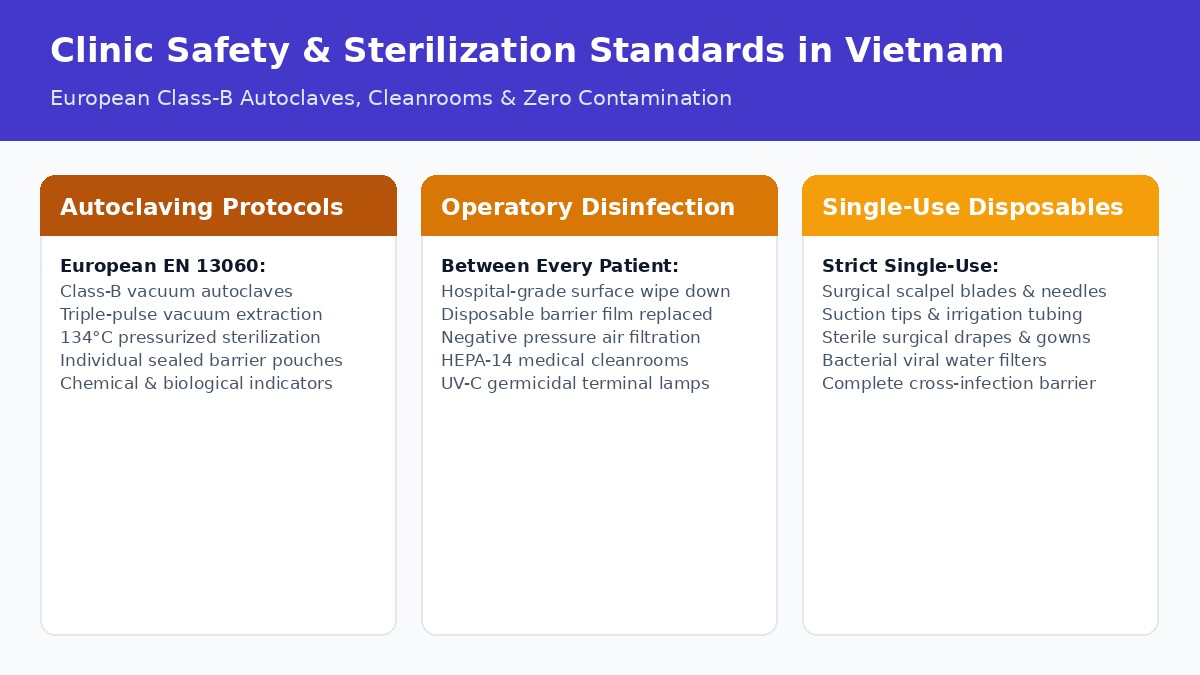
Because international clinics cater specifically to discerning overseas travelers, they invest heavily in European Class-B fractional vacuum autoclaves, hospital-grade cleanrooms, HEPA-14 laminar airflow, and 100% single-use surgical barrier systems.
This comprehensive guide reveals the inner workings of dental sterilization in Vietnam, walking you through the rigorous 5-stage decontamination cycle and providing a point-of-care safety audit checklist.

1. The Gold Standard: European EN 13060 Class-B Autoclaves
Sterilization is not simply running hot water over metal tools. Modern dentistry requires fractional vacuum steam autoclaving:
CLASS-N VS. CLASS-B AUTOCLAVE COMPARISON
To review surgical implant procedures utilizing Class-B protocols, explore: Single vs Multiple vs All-on-4 Implants: Which Do You Need?.
| Feature | Older Class-N Autoclaves (Common in small clinics) | European Class-B Units (Standard in Da Nang) |
|---|---|---|
| Vacuum Technology | Simple gravity displacement; air remains trapped inside hollow instruments | Triple-pulse fractionated vacuum pump removes 99% of air before steam |
| Hollow Handpieces (Turbines & Drills) | CANNOT reliably sterilize internal turbine water lines | 100% STERILIZATION of complex surgical lumens |
| Operating Cycle | 121°C static heat | 134°C high-pressure saturated steam |
| Verification Tracking | Visual thermometer check only | Microprocessor datalogger with barcoded printout |
2. The 5-Stage Decontamination Cycle in Da Nang
Every reusable clinical instrument undergoes a rigorous, standardized multi-step sterilization workflow:

THE 5-STAGE INSTRUMENT STERILIZATION CYCLE
| STAGE 1: Enzymatic Pre-Soak | Instruments immersed in multi-enzymatic disinfectant bath to dissolve organic protein matter and biological debris |
|---|---|
| STAGE 2: Ultrasonic Cavitation | High-frequency ultrasonic bath scours microscopic crevices and drill flutes |
| STAGE 3: Thermal Disinfection | Automated washer-disinfector rinses, dries, and lubricates surgical turbines |
| STAGE 4: Hermetic Pouch Sealing | Instruments sealed in medical-grade barrier pouches with chemical indicator |
| STAGE 5: Class-B Autoclave Cycle | 134°C vacuum steam cycle; barcoded label stamped with batch number & expiry date |
3. Operatory Hygiene & Environmental Cleanrooms
Infection control extends beyond instruments to the entire physical clinic environment:
- HEPA-14 Laminar Air Filtration: Dedicated surgical suites maintain continuous positive or negative pressure air filtration, exchanging room air 20 times per hour to eliminate 99.995% of airborne pathogens.
- Surface Barrier Protection: All dental chair touchpoints—including overhead operating lights, X-ray heads, computer keyboards, and delivery hoses—are wrapped in medical disposable plastic film, replaced between every patient.
- Surface Virucidal Decontamination: Operatory countertops, patient chairs, and spittoons are thoroughly scrubbed with hospital-grade disinfectant solutions (effective against Hepatitis B, C, HIV, and Mycobacteria) with a mandatory 10-minute contact dwell time.
- UV-C Germicidal Nightly Sterilization: At the conclusion of each clinical day, surgical suites are sealed and bathed in UV-C germicidal light to achieve terminal microbial eradication.
To inspect accredited hospital standards, visit: Da Nang Dental Hub.
4. Single-Use Surgical Disposables
Certain critical items are strictly single-use and disposed of in medical sharps containers immediately after use:
- Anesthetic cartridges, single-use sterile syringes, and ultra-fine needles.
- Diamond surgical burs, scalpel blades, and bone-harvesting scrapers.
- Sterile surgical gowns, patient head drapes, and silicone saliva suction tubes.
- Dental bibs, mouthwash cups, and nitrile powder-free examination gloves.
To explore all-inclusive packages conducted in these surgical environments, see: All-Inclusive Dental Treatment Packages in Vietnam.
Practical tip: Save your clinic coordinator's messaging number in your phone before you fly. When a question pops up at 10pm — about swelling, medication timing, or tomorrow's pickup — you will get an answer in minutes, not the next morning.
<!-- IMAGE SUGGESTION 3 (before FAQ): Before FAQ: confident patient smiling after full-mouth implant restoration -->
Frequently Asked Questions (FAQ)
What sterilization equipment do international dental clinics in Vietnam use?
Accredited dental centers in Vietnam utilize European EN 13060 Class-B fractional vacuum autoclaves (such as German Melag or Swiss W&H units). These autoclaves use triple-pulse fractionated vacuum extraction to eliminate air pockets, ensuring pressurized 134°C steam penetrates deep into the inner lumens of hollow surgical handpieces and drills.
How do clinics prevent cross-contamination between patients?
Clinics enforce a strict multi-barrier infection control protocol: (1) Mandatory single-use disposables (needles, scalpels, suction tips, sterile surgical gowns), (2) Individual heat-sealed barrier pouches for all stainless steel instruments, (3) Color-changing chemical indicators and weekly biological spore tests, and (4) Complete operatory surface disinfection with hospital-grade virucidal solutions between every patient.
Are surgical implant procedures performed in sterile hospital environments?
Yes. In accredited facilities in Da Nang, surgical procedures (such as dental implants and bone grafting) are conducted in dedicated negative-pressure surgical suites equipped with medical-grade HEPA-14 laminar air filtration and UV-C germicidal terminal disinfection.
Can patients witness instrument pouches being opened chairside?
Absolutely. Standard operating procedure requires dental assistants to present the sealed, dated, barcoded sterilization pouch to the patient, pointing out the dark color-change indicator strip before breaking the hermetic seal in front of your eyes.
How do I verify a Vietnamese dental clinic is legitimate?
Check for a Ministry of Health operating license, international accreditations, and named dentists with verifiable training histories. Legitimate clinics publish real treatment plans in writing and never pressure you to decide on the spot.
Is there an age limit for dental implants or major work abroad?
There is no strict age limit — what matters is your general health and bone condition. Patients in their 70s and 80s routinely get implants in Vietnam after a medical review; disclose all medications and conditions during the remote consultation.
5. Waterline Decontamination & Biofilm Eradication
An often overlooked aspect of dental clinic hygiene is dental unit water line (DUWL) safety:
- Independent Distilled Water Reservoirs: Accredited clinics in Da Nang disconnect dental chairs from municipal tap water. Instead, all treatment units draw from dedicated closed reservoirs containing medical-grade distilled water treated with continuous antimicrobial silver ions.
- Weekly Water Testing: Microbiological water tests verify that colony-forming units (CFUs) remain below 50 CFU/mL—far stricter than international drinking water standards (500 CFU/mL).
- Anti-Retraction Handpiece Valves: High-speed surgical handpieces feature patented anti-retraction check valves that prevent oral fluids from being sucked back into the turbine water lines when the foot pedal is released.
<!-- IMAGE SUGGESTION 2 (mid-article): Mid-article: close-up of 3D CBCT scan being reviewed by implant surgeon -->
6. Daily Biological Spore Testing Protocols
Chemical indicator strips alone do not guarantee 100% bacterial eradication:
- Biological Spore Indicators (Geobacillus stearothermophilus): Once a week, resilient bacterial spore test vials are processed through the autoclave cycle and incubated for 24 hours.
- Independent Third-Party Verification: Only when 100% spore destruction is verified is the autoclave cleared for clinical operation. Datalogger printouts are archived in hospital records for 5 years.
7. Air Quality and Negative Pressure Surgical Cleanrooms
To prevent airborne surgical cross-infection:
- Dedicated oral surgery suites feature hospital-grade negative pressure HVAC systems that draw air inward and vent it through medical HEPA-14 filters.
- This creates an ultra-clean surgical environment comparable to open-heart surgical theaters, virtually eliminating post-operative bacterial infection risks for dental implant recipients.
8. Point-of-Care Traceability & Digital Autoclave Logs
Every sterilized instrument pouch carries a thermal barcode label:
- Before surgery, this barcode is scanned directly into your electronic medical record (EMR).
- This creates an immutable digital audit trail proving the exact date, autoclave unit, sterilizing temperature, and cycle time used for every instrument placed in your mouth.
9. Staff Immunization & Cross-Infection Health Records
Clinical team safety is strictly monitored:
- All oral surgeons, nurses, and laboratory ceramists maintain complete, up-to-date immunizations against Hepatitis B, COVID-19, and seasonal influenza.
- Annual occupational health screenings ensure that the healthcare professionals caring for you meet rigorous medical fitness standards.
Uncompromised Clinical Safety in Da Nang, Vietnam
Experience peace of mind knowing your dental care is delivered in ultra-clean, hospital-grade surgical suites meeting the highest international European sterilization standards.
---
This article is for informational purposes only and is not medical advice. Please consult a qualified dentist for diagnosis and treatment options.
What sterilization equipment do international dental clinics in Vietnam use?
Accredited dental centers in Vietnam utilize European EN 13060 Class-B fractional vacuum autoclaves (such as German Melag or Swiss W&H units). These autoclaves use triple-pulse fractionated vacuum extraction to eliminate air pockets, ensuring pressurized 134°C steam penetrates deep into the inner lumens of hollow surgical handpieces and drills.
How do clinics prevent cross-contamination between patients?
Clinics enforce a strict multi-barrier infection control protocol: (1) Mandatory single-use disposables (needles, scalpels, suction tips, sterile surgical gowns), (2) Individual heat-sealed barrier pouches for all stainless steel instruments, (3) Color-changing chemical indicators and weekly biological spore tests, and (4) Complete operatory surface disinfection with hospital-grade virucidal solutions between every patient.
Are surgical implant procedures performed in sterile hospital environments?
Yes. In accredited facilities in Da Nang, surgical procedures (such as dental implants and bone grafting) are conducted in dedicated negative-pressure surgical suites equipped with medical-grade HEPA-14 laminar air filtration and UV-C germicidal terminal disinfection.
Can patients witness instrument pouches being opened chairside?
Absolutely. Standard operating procedure requires dental assistants to present the sealed, dated, barcoded sterilization pouch to the patient, pointing out the dark color-change indicator strip before breaking the hermetic seal in front of your eyes.
How do I verify a Vietnamese dental clinic is legitimate?
Check for a Ministry of Health operating license, international accreditations, and named dentists with verifiable training histories. Legitimate clinics publish real treatment plans in writing and never pressure you to decide on the spot.
Is there an age limit for dental implants or major work abroad?
There is no strict age limit — what matters is your general health and bone condition. Patients in their 70s and 80s routinely get implants in Vietnam after a medical review; disclose all medications and conditions during the remote consultation.
Dental Tourism Vietnam Cost: Complete Price Guide & Financial Planning 2026
Save 70-80% on dental care in Vietnam. Complete 2025 cost guide, procedure comparison vs Australia/US/UK, payment methods, hidden fees & net ROI calculator.
Complete Cost Breakdown: Flight + Hotel + Treatment in Vietnam
Full out-of-pocket cost breakdown for dental tourism in Vietnam. Return flights, 4-star hotels, dental procedures, meals, and real patient budget models.
Dental Tourism Cost Calculator: How to Estimate Your Trip
Calculate your dental tourism savings in Vietnam. 4-step formula: clinic procedures + flights + resort stays + living expenses vs Western costs.
Independent Pre-Trip Resources for International Patients
To ensure your dental travel journey is seamless and well-prepared, we recommend consulting these independent destination and recovery travel guides:
"Read the medical travel & e-Visa preparation guide at VietnamMedicalTravelGuide.com"
• Post-op soft food dining & culinary recovery in Vietnam
"Find 5-star beachfront resorts near dental centers at DaNangDentalHub.com"
• Top 5-star beachfront resorts with clinic concierge shuttles