Dental Technology in Vietnam: 3D Scans, CAD/CAM & Digital Dentistry
Explore dental technology in Vietnam. 3D CBCT scans, iTero intraoral digital scanners, 5-axis CAD/CAM milling, and guided surgery in Da Nang.
By Đội ngũ DentalTreatmentVietnam · Medically reviewed by a licensed dental surgeon · Last updated: October 12, 2026

3D scans, same-day crowns, robot-milled precision — dental tech moves fast. Here is what the equipment actually does for you as a patient, beyond the shiny brochure words.
Over the past decade, dentistry has undergone a monumental digital revolution. The era of uncomfortable goopy impression trays, guessing bone volume on fuzzy 2D X-rays, and waiting two weeks for outsourced crowns has been replaced by real-time 3D optical scanning, virtual bone simulation, robotic sub-micron milling, and computer-guided surgery.
In Vietnam, international dental hospitals in Da Nang and Ho Chi Minh City have not merely adopted these modern tools—they have built their entire clinical infrastructure around full digital workflows.
Because Vietnamese dental centers designed their facilities recently, they bypassed decades of legacy analog equipment. Today, visiting a top dental hospital in Da Nang feels like stepping into a medical center of the future.
This comprehensive guide explores the advanced digital technologies driving Vietnamese dentistry, from 3D CBCT bone diagnostics and intraoral optical scanning to in-house 5-axis CAD/CAM robotic milling and 3D-printed guided surgery.

1. 3D Cone Beam Computed Tomography (CBCT) Diagnostics
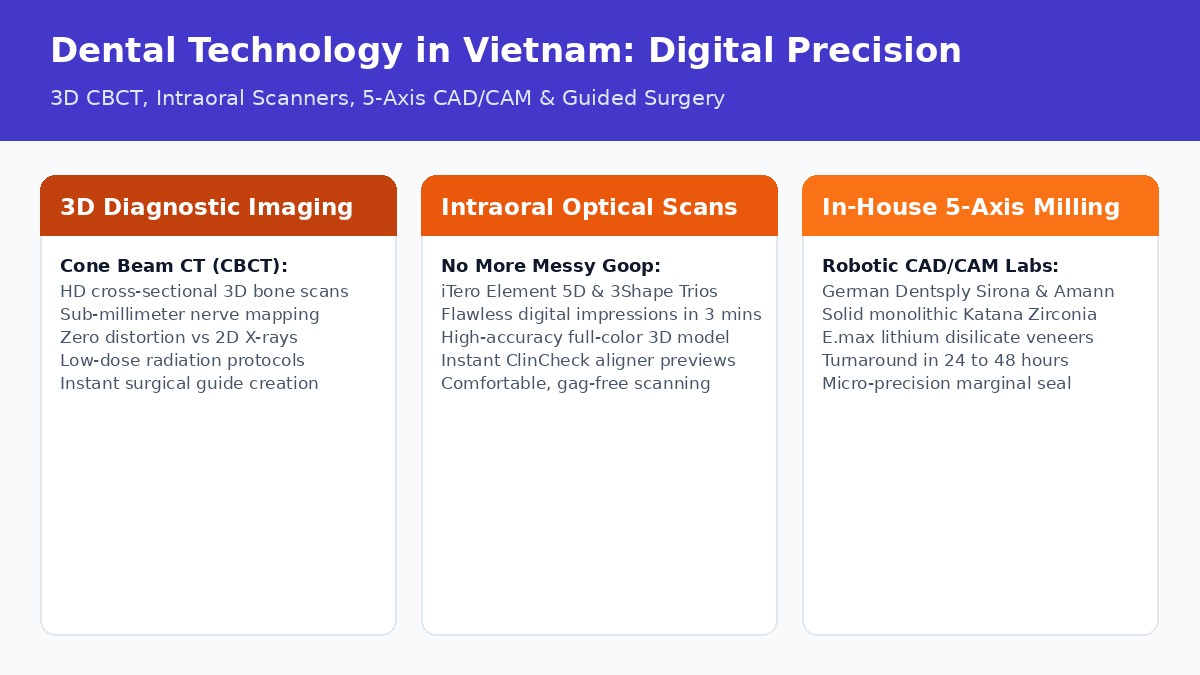
High-resolution 3D diagnostic imaging is the foundation of modern clinical safety:
2D PANORAMIC VS. 3D CBCT DIAGNOSTICS
To review implant procedures planned via 3D CBCT, explore: [Dental Implants Cost: Vietnam vs. Australia vs. USA [2025]](https://dentaltreatmentvietnam.com/services/dental-implants/implant-cost-vietnam-vs-australia).
| Feature | Traditional 2D Panoramic OPG | High-Definition 3D CBCT |
|---|---|---|
| Image Dimensionality | Flat, distorted 2D silhouette with 25% magnification error | 3D volumetric model with 1:1 anatomic accuracy |
| Bone Thickness Measurement | CANNOT evaluate bucco-lingual bone width or concavities | Accurately measures bone width to 0.1 mm precision |
| Nerve Canal Mapping | Approximate visual estimation of inferior alveolar nerve | Sub-millimeter tracking prevents nerve injury |
| Guided Surgery Compatibility | Not compatible | Direct input for 3D- printed surgical stents |
2. Intraoral Optical 3D Scanning: Zero Gagging, Zero Goop
Say goodbye to claustrophobic impression trays filled with cold, dripping silicone goop:
- iTero Element 5D & 3Shape TRIOS: An ultra-light optical wand projects structured light patterns into your mouth, capturing over 6,000 high-definition images per minute.
- Instant Full-Arch Model in 3 Minutes: Your entire dental arch is rendered in high-definition photorealistic 3D color on an operatory monitor before your eyes.
- NIRI Cavity Detection: Near-Infrared Imaging (NIRI) technology detects interproximal enamel caries beneath the surface without ionizing radiation.
- Digital Smile Simulation: Allows you to preview your projected clear aligner progression or veneer smile design before treatment even begins.
To understand orthodontic clear aligner workflows, read: Invisalign Cost in Vietnam vs Australia/US.
3. In-House 5-Axis CAD/CAM Robotic Milling Laboratories
The traditional 10-day wait for outsourced dental prosthetics is completely eliminated in Da Nang:

THE 24-HOUR DIGITAL PROSTHETIC WORKFLOW
To review restorative crown options, explore: Dental Tourism Vietnam Cost: Complete Price Guide 2025.
| STAGE 1: 3D Intraoral Optical Scan | Optical wand captures tooth prep in 3 min |
|---|---|
| STAGE 2: CAD Computer Design | Master ceramist designs crown anatomy on 3Shape dental software chairside |
| STAGE 3: 5-Axis Robotic Milling | German industrial milling machine carves monolithic zirconia block with diamonds |
| STAGE 4: High-Temp Sintering | Ceramic furnace bakes restoration at 1,500°C for maximum structural strength |
| STAGE 5: Hand Glaze & Delivery | Artistic porcelain staining and permanent seating completed within 24 to 48 hours! |
4. Computer-Guided Implantology: Sub-Millimeter Accuracy
Dental implant surgery in Da Nang is no longer performed by freehand visual estimation:
- Virtual Implant Placement: Oral surgeons pre-plan the precise diameter, length, angulation, and depth of each fixture in 3D software weeks before your arrival.
- 3D-Printed Surgical Guides: A custom stereolithographic surgical stent is 3D-printed. During surgery, the guide rests securely on your gums, and titanium drill sleeves guide the osteotomy drills with zero chance of deviation.
- Minimal Invasive Flapless Surgery: In many cases, incisions and sutures are unnecessary; implants are placed through tiny 4 mm keyholes, drastically reducing post-operative swelling, bleeding, and recovery downtime.
To check clinic technology infrastructure, visit: Da Nang Dental Hub.
Practical tip: Ask to see your own 3D scan during consultation. A clinic that walks you through your CBCT images is showing you real diagnostics, not just expensive decor.

Frequently Asked Questions (FAQ)
What digital imaging technology is used in Vietnamese dental clinics?
Accredited dental centers utilize high-resolution Cone Beam Computed Tomography (3D CBCT) scanners (such as Planmeca, Vatech, or Dentsply Sirona). These systems generate 3D multi-planar reconstructions of jawbone density, nerve canals, and maxillary sinuses with sub-millimeter precision at significantly lower radiation doses than medical CT scans.
Are traditional messy impression molds still used for crowns and veneers?
No! Leading clinics in Da Nang have completely replaced uncomfortable alginate trays with high-speed intraoral optical scanners (iTero Element 5D and 3Shape Trios). In under 3 minutes, an optical wand captures thousands of photorealistic 3D color frames per second, creating a perfect digital impression without gagging.
What is an in-house CAD/CAM dental laboratory?
An in-house Computer-Aided Design / Computer-Aided Manufacturing (CAD/CAM) lab allows clinics to design and mill custom ceramic prosthetics directly on-site using 5-axis robotic milling machines (German Dentsply Sirona CEREC and Amann Girrbach). This slashes crown and veneer fabrication times from 7 days down to just 24 to 48 hours.
How does computer-guided surgery improve dental implant safety?
Surgeons merge the patient's 3D CBCT bone scan with their intraoral optical scan in virtual 3D planning software. A custom surgical guide (stent) is 3D-printed with titanium guide sleeves, locking the exact depth, angle, and position of each implant. This eliminates human error, avoids nerve damage, and shortens surgery times to under 30 minutes per fixture.
Does 3D-guided surgery cost extra?
It can, but it often pays for itself in precision — smaller incisions, faster healing, and fewer surprises. Ask whether guided planning is included in your quote or itemized separately.
Is a same-day crown as good as a lab-made crown?
For many cases, yes — modern in-house milling produces excellent monolithic zirconia crowns. Complex aesthetic front-tooth work may still go to a master ceramist lab. Your dentist should match the method to the case, not to the marketing.
5. Dynamic Computer Navigation & Robotic Guidance
In addition to static 3D-printed surgical stents, premier hospital centers in Da Nang utilize Dynamic 3D Surgical Navigation:
- GPS-Like Optical Tracking: Motion-tracking optical cameras follow infrared sensors attached to the patient’s jaw and the surgeon’s handpiece in real time.
- Instant Depth & Angle Feedback: The surgical monitor displays a 3D avatar of the drill moving through the patient’s bone in real time, alerting the surgeon if the trajectory deviates by even 0.2 millimeters.
- Enhanced Safety Near Vital Structures: Dynamic navigation provides unprecedented protection when navigating anatomical challenges like severely atrophied jaws or close proximity to the maxillary sinus.
6. Digital Occlusal Balance: T-Scan Computer Bite Analysis
Traditional carbon articulating paper only shows where teeth touch, but cannot measure force or timing:
- T-Scan Novus Digital Occlusal Sensors: Patients bite down on an ultra-thin sensor wafer that measures biting force distribution in 0.003-second increments.
- Eliminating Premature Contacts: Computer software identifies microscopic high spots that could cause ceramic chipping or implant overload, allowing prosthodontists to balance bite forces with mathematical perfection.
7. Dental Photogrammetry for Full-Arch All-on-4
Accurately capturing the 3D positions of multiple dental implants has traditionally been difficult with standard cameras:
- Micron-Level Photogrammetry: Clinics in Da Nang utilize specialized high-speed photogrammetric scanning cameras (such as Imetric 4D or MicronMapper).
- Sub-10-Micron Accuracy: Photogrammetry triangulates the exact three-dimensional spatial coordinates and angulation of all 4 or 6 implants in seconds.
- Stress-Free Passive Fit: This guarantees that your permanent monolithic zirconia bridge seats passively on all implant fixtures with zero mechanical tension, preventing bone resorption or screw loosening.

Experience the Future of Digital Dentistry in Vietnam
Benefit from computer-guided precision, instant 3D optical scans, and rapid 24-hour CAD/CAM ceramic milling in Da Nang, Vietnam.
---
This article is for informational purposes only and is not medical advice. Please consult a qualified dentist for diagnosis and treatment options.
What digital imaging technology is used in Vietnamese dental clinics?
Accredited dental centers utilize high-resolution Cone Beam Computed Tomography (3D CBCT) scanners (such as Planmeca, Vatech, or Dentsply Sirona). These systems generate 3D multi-planar reconstructions of jawbone density, nerve canals, and maxillary sinuses with sub-millimeter precision at significantly lower radiation doses than medical CT scans.
Are traditional messy impression molds still used for crowns and veneers?
No! Leading clinics in Da Nang have completely replaced uncomfortable alginate trays with high-speed intraoral optical scanners (iTero Element 5D and 3Shape Trios). In under 3 minutes, an optical wand captures thousands of photorealistic 3D color frames per second, creating a perfect digital impression without gagging.
What is an in-house CAD/CAM dental laboratory?
An in-house Computer-Aided Design / Computer-Aided Manufacturing (CAD/CAM) lab allows clinics to design and mill custom ceramic prosthetics directly on-site using 5-axis robotic milling machines (German Dentsply Sirona CEREC and Amann Girrbach). This slashes crown and veneer fabrication times from 7 days down to just 24 to 48 hours.
How does computer-guided surgery improve dental implant safety?
Surgeons merge the patient's 3D CBCT bone scan with their intraoral optical scan in virtual 3D planning software. A custom surgical guide (stent) is 3D-printed with titanium guide sleeves, locking the exact depth, angle, and position of each implant. This eliminates human error, avoids nerve damage, and shortens surgery times to under 30 minutes per fixture.
Does 3D-guided surgery cost extra?
It can, but it often pays for itself in precision — smaller incisions, faster healing, and fewer surprises. Ask whether guided planning is included in your quote or itemized separately.
Is a same-day crown as good as a lab-made crown?
For many cases, yes — modern in-house milling produces excellent monolithic zirconia crowns. Complex aesthetic front-tooth work may still go to a master ceramist lab. Your dentist should match the method to the case, not to the marketing.
Dental Tourism Vietnam Cost: Complete Price Guide & Financial Planning 2026
Save 70-80% on dental care in Vietnam. Complete 2025 cost guide, procedure comparison vs Australia/US/UK, payment methods, hidden fees & net ROI calculator.
Complete Cost Breakdown: Flight + Hotel + Treatment in Vietnam
Full out-of-pocket cost breakdown for dental tourism in Vietnam. Return flights, 4-star hotels, dental procedures, meals, and real patient budget models.
Dental Tourism Cost Calculator: How to Estimate Your Trip
Calculate your dental tourism savings in Vietnam. 4-step formula: clinic procedures + flights + resort stays + living expenses vs Western costs.
Independent Pre-Trip Resources for International Patients
To ensure your dental travel journey is seamless and well-prepared, we recommend consulting these independent destination and recovery travel guides:
"View the comprehensive pre-trip medical checklist at VietnamMedicalTravelGuide.com"
• Post-op soft food dining & culinary recovery in Vietnam
"View airport transit times and clinic neighborhood maps at DaNangDentalHub.com"
• Top 5-star beachfront resorts with clinic concierge shuttles