Titanium vs Zirconia Implants: Which Is Right for You?
Compare titanium and ceramic zirconia dental implants in Vietnam. Osseointegration rates, aesthetic differences, metal-free biocompatibility, and cost guide.
By Đội ngũ DentalTreatmentVietnam · Medically reviewed by a licensed dental surgeon · Last updated: October 12, 2026
A note on prices: All prices in this article are shown as indicative ranges (not fixed quotes) and were last reviewed in October 2026. Your clinic will confirm an exact written quote before treatment begins.

Titanium has six decades of proof behind it; zirconia has the metal-free appeal. If you are torn between them, here is the no-hype comparison that dentists give their own families.
For more than six decades, medical-grade titanium has served as the undisputed gold standard of oral implantology. With hundreds of millions of successful placements worldwide, its unique ability to physically bond with human jawbone (osseointegration) has transformed modern restorative care.
In recent years, however, rapid advancements in high-performance bioceramics have propelled Zirconia (Ceramic) Implants into the global spotlight. Promoted as a 100% metal-free, hypoallergenic alternative with pristine gumline aesthetics, ceramic fixtures are increasingly requested by health-conscious dental tourists and holistic health advocates.
If you are researching tooth replacement in Vietnam, this guide offers an objective clinical comparison between titanium and zirconia fixtures, helping you make an informed decision based on your oral biology, aesthetic goals, and budget.

1. Material Properties & Biocompatibility: Understanding the Difference
While patients frequently assume zirconia is a brittle porcelain similar to a coffee mug, it is actually zirconium dioxide (ZrO2)—a crystal lattice ceramic engineered for high-stress aerospace and biomedical applications (such as artificial hip joints).
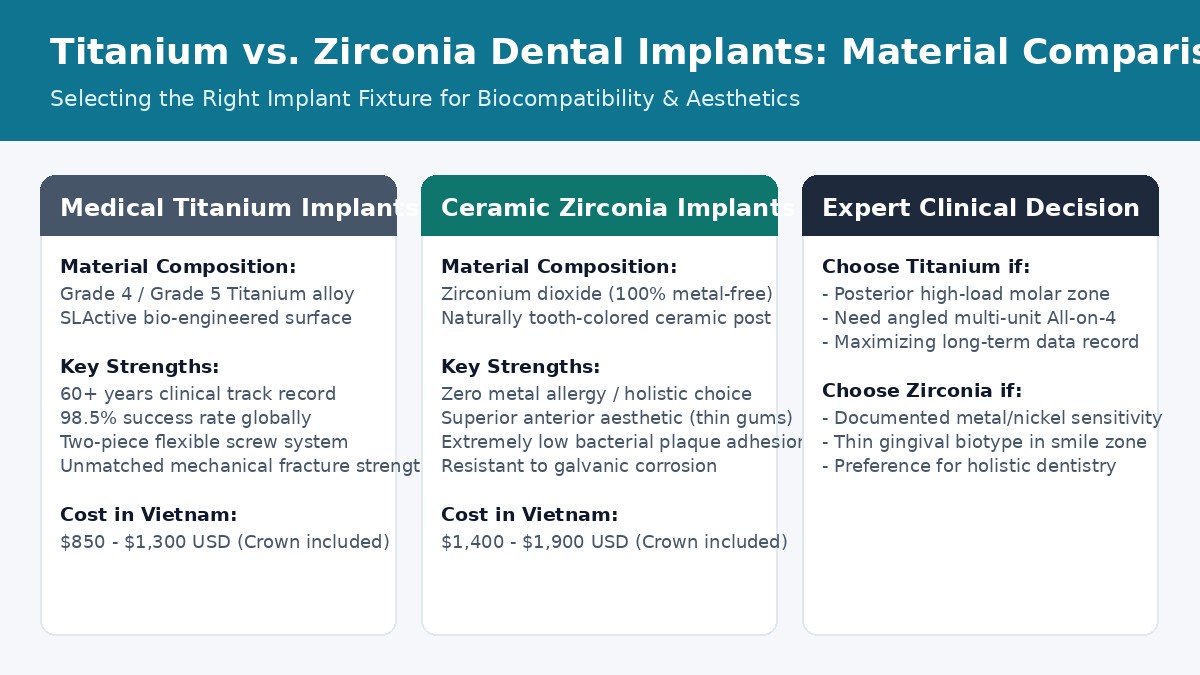
| Titanium Implant System | Zirconia Ceramic Implant System |
|---|---|
| • Material: Grade 4 pure titanium or Ti-6Al-4V Grade 5 alloy • Architecture: 2-piece design (screw-retained separate abutment) • Color: Metallic dark gray • History: 60+ years human data • Electrical: Conductive metal | • Material: Yttria-stabilized tetragonal zirconia ceramic • Architecture: Monobloc 1-piece or precision 2-piece design • Color: Naturally ivory/white • History: ~20 years clinical data • Electrical: Dielectric non-metal |
Titanium: The Biomechanical Workhorse
- Decades of Empirical Evidence: Titanium has been tracked across multi-decade peer-reviewed clinical trials, proving documented long-term success rates exceeding 98.5%.
- Versatile Two-Piece Modular Design: Because the fixture and abutment are separate components connected by an internal screw, oral surgeons can correct slight angulation discrepancies, custom-mill abutments, and perform complex multi-unit full-mouth bridgework with complete biomechanical flexibility.
- Micro-Rough Surfaces: Advanced surface treatments like Straumann’s chemically active SLActive® surface draw blood proteins instantly, shortening osseointegration windows to just 3 to 4 weeks in healthy bone.
Zirconia: The Metal-Free Aesthetic Frontier
- 100% Metal-Free & Non-Corrosive: Zirconia does not conduct electrical micro-currents (galvanism) and is chemically inert, meaning it cannot corrode or release trace metal ions into surrounding tissues.
- Superior Soft Tissue Adaptation: Human gingival fibroblasts adhere remarkably well to zirconia surfaces. Scientific studies confirm that ceramic implants exhibit significantly lower bacterial plaque accumulation compared to titanium, reducing the risk of peri-implant mucositis.
- Zero Gray Line Risk: The white ceramic post mimics the shade of a natural tooth root. Even if gum tissue thins with age, no dark metallic shadow will ever show through.
To review core implant anatomy, consult: What is a Dental Implant? Complete Beginner's Guide.
2. Aesthetic Performance: The Smile Zone Showdown
The single greatest clinical advantage of zirconia implants lies in the anterior aesthetic zone—your upper front teeth.
AESTHETIC GUM MARGIN COMPARISON
[ Titanium Implant ] [ Zirconia Implant ]
Natural Light Penetration Natural Light Penetration
[Thin Gums] [Thin Gums]
[ Gray Shadow ] [ Pristine Pink Gum ]
(Dark metallic shadow (Translucent ivory post
shows through delicate tissue) maintains natural brightness)
The Thin Gingival Biotype Challenge
Approximately 30% of human patients possess a "thin gingival biotype"—meaning their gum tissue is delicate, thin, and semi-translucent. When a gray titanium implant is placed in someone with thin gums, the metal underneath can cast an unsightly dark or bluish hue along the gumline.
Furthermore, if the gumline naturally recedes over a decade of aging, the metallic neck of a titanium post may become visible when smiling. With a zirconia ceramic implant, the white substrate ensures that even if minor recession occurs, the exposed collar looks completely natural, identical to biological tooth enamel.
To understand aesthetic configurations across single and multiple teeth, see: Single vs Multiple vs All-on-4 Implants: Which Do You Need?.
3. Mechanical Strength & Placement Limitations
Despite its aesthetic appeal, zirconia ceramic has distinct physical boundaries that oral surgeons must respect:
1. Flexural Toughness: Titanium bends slightly under extreme pressure before deforming; ceramic does not bend—if stress exceeds its threshold, it risks micro-fracture. Consequently, titanium remains the mandatory choice for heavy molar bite forces and patients who suffer from severe nocturnal teeth clenching (bruxism).
2. Full-Arch Angle Limitations: In All-on-4 full-arch restorations, posterior implants must be tilted at 30 to 45 degrees. Zirconia fixtures cannot easily tolerate these high-angle shearing forces. Therefore, All-on-4 and All-on-6 full-mouth restorations are almost universally constructed on medical titanium anchors.
To review full-arch biomechanics, read: All-on-4 vs All-on-6 Dental Implants in Vietnam.

4. Cost Comparison: Vietnam vs Australia & United States
Because ceramic implants require diamond-tool milling, specialized cleanroom manufacturing, and high-purity zirconia powders, they carry a price premium over standard titanium fixtures. In Vietnam, however, both options remain exceptionally affordable.
For complete financial comparisons, see: [Dental Implants Cost: Vietnam vs. Australia vs. USA [2025]](https://dentaltreatmentvietnam.com/services/dental-implants/implant-cost-vietnam-vs-australia) and discover packaged travel deals in All-Inclusive Dental Treatment Packages in Vietnam.
| Implant System (Complete Package) | Australia (AUD $) | Vietnam Certified |
|---|---|---|
| Premium Medical Titanium Implant (Straumann / Dentium + Crown) | $4,500 – $6,200 AUD ($3,000 – $4,200 USD) | $1,300 – $2,000 AUD ($850 – $1,300 USD) |
| Ceramic Zirconia Implant (Straumann PURE / SDS + Crown) | $6,500 – $8,500 AUD ($4,400 – $5,800 USD) | $2,100 – $2,850 AUD ($1,400 – $1,900 USD) |
5. Clinical Recommendation: How to Choose
- Select Titanium Implants if:
- You are restoring posterior molars where chewing pressure is immense.
- You require full-arch All-on-4 or All-on-6 rehabilitation.
- You have average-to-thick gum tissue where metallic shadowing is not a clinical concern.
- You want the security of 60+ years of long-term scientific documentation at the lowest possible cost.
- Select Ceramic Zirconia Implants if:
- You are restoring a visible front tooth (central incisor, lateral incisor, canine) and have a thin gum biotype.
- You have a documented metal sensitivity or allergy to titanium, nickel, or trace alloys.
- You follow a holistic lifestyle and want 100% metal-free biological dentistry.
- You want maximum resistance to bacterial plaque adhesion along the gumline.
To check clinic certifications and equipment in Da Nang, visit: Da Nang Dental Hub.
Practical tip: Ask how many zirconia implants your surgeon places per year. Titanium protocols are universal; zirconia demands specific experience, and case volume is the most honest quality signal.

Frequently Asked Questions (FAQ)
What is the main difference between titanium and zirconia dental implants?
Titanium implants are manufactured from medical-grade titanium alloy (Grade 4 or Grade 5), featuring a two-piece design (fixture plus separate abutment) backed by over 60 years of clinical research and a 98%+ success rate. Zirconia implants are 100% ceramic (zirconium dioxide), naturally tooth-colored (white), non-metallic, and completely hypoallergenic, making them the preferred choice for holistic dentistry and thin gum biotypes.
Are zirconia dental implants as durable as titanium implants?
Modern yttria-stabilized tetragonal zirconia polycrystal (Y-TZP) ceramic possesses exceptional compressive strength (over 1,200 MPa) and is highly fracture-resistant. However, titanium still demonstrates higher flexural yield strength and fracture toughness under extreme off-axis chewing loads. For posterior molars or angled full-arch restorations, titanium remains the superior biomechanical choice. For single front teeth, zirconia offers comparable long-term durability with superior gumline aesthetics.
Can I get ceramic zirconia implants in Vietnam?
Yes. Leading international clinics in Da Nang and Ho Chi Minh City offer FDA and CE-certified European ceramic implant systems (such as Straumann PURE Ceramic and Swiss Dental Solutions SDS). These are placed by certified implantologists utilizing computer-guided surgical templates.
How much more expensive are zirconia implants compared to titanium in Vietnam?
In Vietnam, a premium titanium implant (e.g., Straumann or Dentium) complete with custom abutment and zirconia crown costs $850 to $1,300 USD ($1,300 to $2,000 AUD). A ceramic zirconia implant complete with crown costs $1,400 to $1,900 USD ($2,100 to $2,850 AUD). In Australia or the US, zirconia implants cost upwards of $5,500 to $7,500 USD.
I have metal allergies — are zirconia implants safer for me?
True titanium allergy is rare, but zirconia is the standard recommendation for patients with confirmed metal sensitivities. Get the allergy properly tested first rather than self-diagnosing — it changes the whole treatment plan.
Do zirconia implants cost more than titanium?
Generally yes — the fixtures cost more to manufacture and fewer clinics place them. Get itemized quotes for both options from the same clinic so you are comparing like with like.

Consult an Expert Implantologist in Vietnam
Whether you opt for the proven track record of Swiss titanium or the pristine aesthetics of ceramic zirconia, Vietnam's premier dental specialists ensure precision digital placement, authentic international components, and profound savings.
---
This article is for informational purposes only and is not medical advice. Please consult a qualified dentist for diagnosis and treatment options.
What is the main difference between titanium and zirconia dental implants?
Titanium implants are manufactured from medical-grade titanium alloy (Grade 4 or Grade 5), featuring a two-piece design (fixture plus separate abutment) backed by over 60 years of clinical research and a 98%+ success rate. Zirconia implants are 100% ceramic (zirconium dioxide), naturally tooth-colored (white), non-metallic, and completely hypoallergenic, making them the preferred choice for holistic dentistry and thin gum biotypes.
Are zirconia dental implants as durable as titanium implants?
Modern yttria-stabilized tetragonal zirconia polycrystal (Y-TZP) ceramic possesses exceptional compressive strength (over 1,200 MPa) and is highly fracture-resistant. However, titanium still demonstrates higher flexural yield strength and fracture toughness under extreme off-axis chewing loads. For posterior molars or angled full-arch restorations, titanium remains the superior biomechanical choice. For single front teeth, zirconia offers comparable long-term durability with superior gumline aesthetics.
Can I get ceramic zirconia implants in Vietnam?
Yes. Leading international clinics in Da Nang and Ho Chi Minh City offer FDA and CE-certified European ceramic implant systems (such as Straumann PURE Ceramic and Swiss Dental Solutions SDS). These are placed by certified implantologists utilizing computer-guided surgical templates.
How much more expensive are zirconia implants compared to titanium in Vietnam?
In Vietnam, a premium titanium implant (e.g., Straumann or Dentium) complete with custom abutment and zirconia crown costs $850 to $1,300 USD ($1,300 to $2,000 AUD). A ceramic zirconia implant complete with crown costs $1,400 to $1,900 USD ($2,100 to $2,850 AUD). In Australia or the US, zirconia implants cost upwards of $5,500 to $7,500 USD.
I have metal allergies — are zirconia implants safer for me?
True titanium allergy is rare, but zirconia is the standard recommendation for patients with confirmed metal sensitivities. Get the allergy properly tested first rather than self-diagnosing — it changes the whole treatment plan.
Do zirconia implants cost more than titanium?
Generally yes — the fixtures cost more to manufacture and fewer clinics place them. Get itemized quotes for both options from the same clinic so you are comparing like with like.
Dental Tourism Vietnam Cost: Complete Price Guide & Financial Planning 2026
Save 70-80% on dental care in Vietnam. Complete 2025 cost guide, procedure comparison vs Australia/US/UK, payment methods, hidden fees & net ROI calculator.
Complete Cost Breakdown: Flight + Hotel + Treatment in Vietnam
Full out-of-pocket cost breakdown for dental tourism in Vietnam. Return flights, 4-star hotels, dental procedures, meals, and real patient budget models.
Dental Tourism Cost Calculator: How to Estimate Your Trip
Calculate your dental tourism savings in Vietnam. 4-step formula: clinic procedures + flights + resort stays + living expenses vs Western costs.
Independent Pre-Trip Resources for International Patients
To ensure your dental travel journey is seamless and well-prepared, we recommend consulting these independent destination and recovery travel guides:
"View the comprehensive pre-trip medical checklist at VietnamMedicalTravelGuide.com"
• Post-op soft food dining & culinary recovery in Vietnam
"View airport transit times and clinic neighborhood maps at DaNangDentalHub.com"
• Top 5-star beachfront resorts with clinic concierge shuttles