What is a Dental Implant? Complete Beginner's Guide
Understand dental implants from fixture to crown. Learn biological osseointegration, benefits vs bridges/dentures, procedural steps, and costs in Vietnam.
By Đội ngũ DentalTreatmentVietnam · Medically reviewed by a licensed dental surgeon · Last updated: October 12, 2026
A note on prices: All prices in this article are shown as indicative ranges (not fixed quotes) and were last reviewed in October 2026. Your clinic will confirm an exact written quote before treatment begins.

New to the idea of dental implants? Start here. This plain-English guide covers what they are, how they work, and what the journey looks like — no dental degree required.
Losing a permanent tooth—whether due to severe decay, advanced periodontal disease, or physical trauma—can be a distressing experience. Beyond the noticeable gap in your smile, a missing tooth disrupts your ability to chew comfortably, alters your facial muscle balance, and triggers gradual, irreversible bone loss in your jaw.
For decades, patients missing teeth had only two restorative options: removable plastic dentures or fixed tooth-supported bridges. Today, modern restorative dentistry considers dental implants the undisputed gold standard for permanent tooth replacement.
If you are exploring tooth replacement options and considering traveling for care, this comprehensive guide to dental implants in Vietnam explains the anatomical structure of an implant, the biology of bone integration, the advantages over older alternatives, and what to expect during treatment.

1. The Three Anatomical Components of a Dental Implant
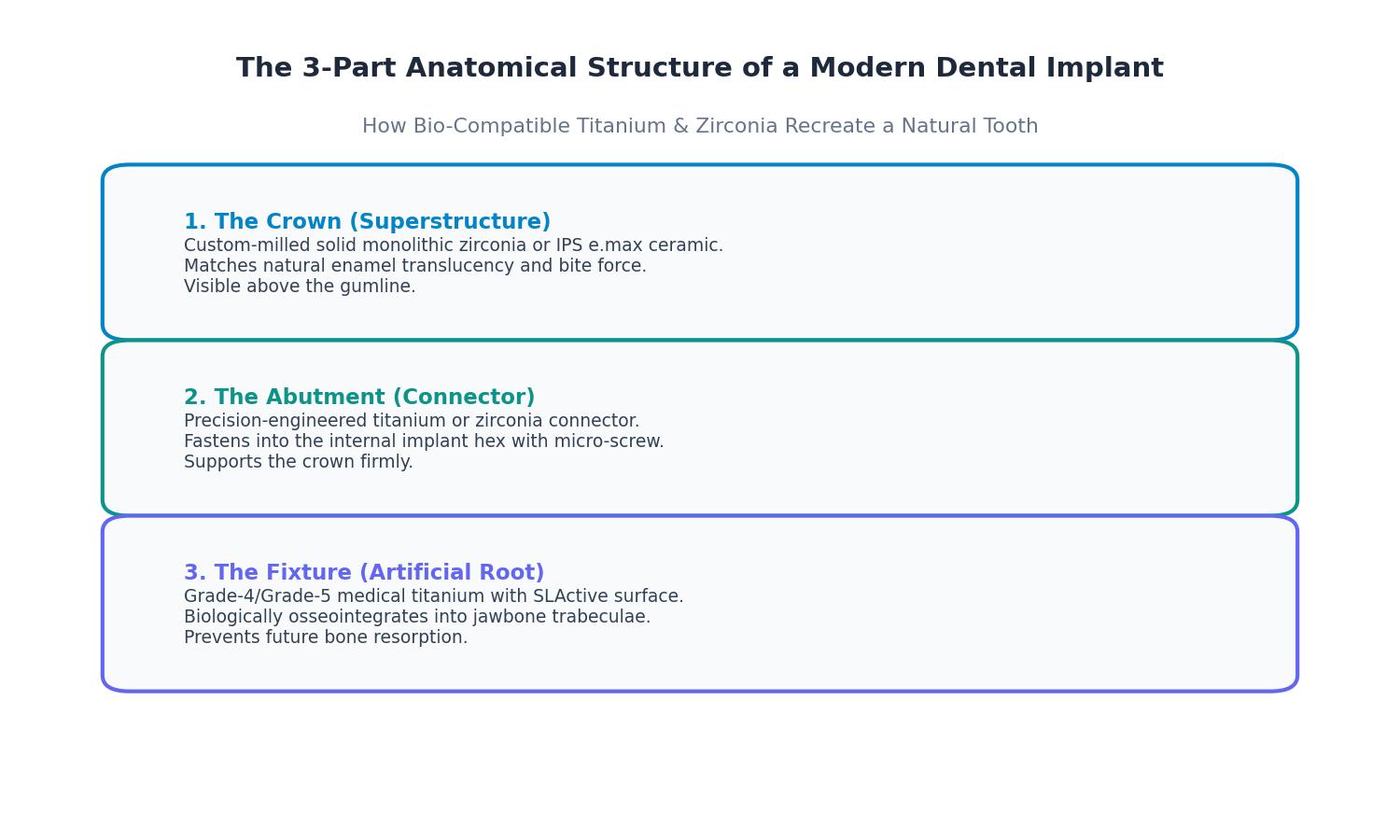
A dental implant is not simply a single artificial tooth; it is a sophisticated, three-part bio-mechanical prosthetic assembly engineered to replicate the complete structure of a natural tooth from root to crown.
[ 1. THE CROWN ] -> Custom CAD/CAM Ceramic (Visible Tooth)
[ 2. THE ABUTMENT ] -> Titanium/Zirconia Connector
[ 3. THE FIXTURE ] -> Titanium Screw Integrated in Bone (Root)
1. The Implant Fixture (Artificial Root)
The fixture is a threaded screw or cylinder manufactured from commercially pure Grade-4 titanium or titanium-zirconium alloy (such as Straumann Roxolid®). Surgically inserted directly into the alveolar jawbone, it acts as an artificial tooth root. The surface is treated with microscopic acid-etching and sandblasting (SLA surface) to encourage bone cells to fuse directly with the metal.
2. The Abutment (The Connector)
Once the implant fixture has bonded with your jawbone, a connector known as an abutment is securely fastened into the fixture's internal connection chamber using a precision micro-screw. The abutment emerges through the gumline, serving as the solid foundation upon which your final tooth crown will sit.
3. The Prosthetic Crown (The Visible Tooth)
The crown is the custom-crafted, tooth-colored replacement tooth visible when you smile and chew. In modern Vietnamese dental laboratories, crowns are custom-milled from solid monolithic zirconia or lithium disilicate (IPS e.max®) using high-precision 5-axis CAD/CAM milling units, matching the exact color, translucency, and contour of your adjacent natural teeth.
To compare different metal and ceramic materials, read our technical breakdown: Titanium vs. Zirconia Implants: Which Is Right for You?.
2. The Biology of Osseointegration: Why Implants Work
The scientific miracle behind dental implants is a natural physiological process called osseointegration, first discovered in 1952 by Swedish orthopedic surgeon Professor Per-Ingvar Brånemark.
When a sterile titanium post is placed into living jawbone under controlled surgical conditions, bone tissue does not recognize the titanium as a foreign threat. Instead, osteoblasts (specialized bone-forming cells) attach directly to the microscopic porous surface of the metal, weaving a dense structural mesh of living trabecular bone around the threads.
Within 8 to 12 weeks, the implant becomes biologically fused with your skeleton, achieving exceptional mechanical stability capable of withstanding hundreds of pounds of biting force.
HOW OSSEOINTEGRATION PROTECTS YOUR JAW
| Oral Condition | Biological Impact | Long-Term Consequence |
|---|---|---|
| Natural Tooth Present | Masticatory chewing forces stimulate bone | Alveolar bone volume remains stable and robust |
| Missing Tooth (No Replacement) | Zero physical chewing stimulation in socket | 25% of jawbone width resorbs within the first 12 months |
| Dental Bridge / Denture | Rests on surface gums; zero root stimulation | Bone continues to shrink under the pontic; loose fit occurs |
| Dental Implant Restored | Restores 100% root chewing stimulation | Stops bone loss completely; preserves facial bone contour |
3. Dental Implants vs. Bridges and Removable Dentures
If you are missing teeth, understanding how dental implants compare to legacy restorative alternatives clarifies why millions of patients choose to invest in implantology.
Implants vs. Fixed Dental Bridges
A traditional dental bridge requires grinding down two perfectly healthy adjacent teeth (abutment teeth) into pegs to support a three-unit bridge spanning the empty gap.
- The Drawback of Bridges: Cutting away healthy enamel permanently compromises adjacent teeth, making them vulnerable to recurrent decay and nerve death. Bridges also fail to stimulate the underlying jawbone, leading to sunken gum lines over time.
- The Implant Advantage: A dental implant is completely self-supporting. It replaces the missing tooth without cutting or stressing neighboring natural teeth.
Implants vs. Removable Dentures
Removable partial or full dentures rest on delicate gum tissues, held in place with metal clasps or sticky adhesive pastes.
- The Drawback of Dentures: Dentures slip while speaking, reduce chewing efficiency by over 70%, and accelerate jawbone atrophy through chronic surface pressure.
- The Implant Advantage: Implants are anchored securely into the jawbone, eliminating embarrassing slippage and restoring 95%+ of natural chewing power.
To evaluate whether you need a single fixture, multiple implants, or a full-arch solution, read: Single vs. Multiple vs. All-on-4 Implants: Which Do You Need?.

4. The Dental Implant Procedure: Step-by-Step
Undergoing dental implant treatment in an accredited international clinic in Vietnam follows a standardized, highly predictable clinical protocol.
[ Step 1: 3D CBCT Diagnostics ] -> Sub-millimeter digital surgical planning
[ Step 2: Surgical Fixture Placement ] -> Pain-free computer-guided placement
[ Step 3: Osseointegration (Healing) ] -> Bone fuses securely with titanium
[ Step 4: Abutment & Crown Delivery ] -> Custom CAD/CAM zirconia tooth attached
Step 1: Comprehensive Diagnostics & 3D Planning
Your treatment begins with a low-dose 3D Cone Beam Computed Tomography (CBCT) scan and an optical intraoral scan using an iTero or 3Shape scanner. Specialized surgical software maps your jawbone density, nerve pathways, and sinus cavities, designing a 3D surgical stent for computer-guided placement.
Step 2: Painless Surgical Placement (30 to 45 Minutes)
Under local anesthesia, a minor pinpoint entry is created in the gum tissue. Using calibrated surgical drills, the implant osteotomy is prepared, and the titanium fixture is gently threaded into position. A healing cap is placed, and dissolvable sutures close the site. The entire procedure is virtually painless.
Step 3: Healing & Temporary Aesthetics
Over the next 8 to 12 weeks, osseointegration occurs. If the implant is located in your visible smile line, a lifelike aesthetic temporary crown is placed so you never leave the clinic with a gap.
Step 4: Final Crown Placement & Permanent Bite
Once osseointegration is confirmed via digital X-rays, the healing cap is replaced with your permanent custom abutment. The master laboratory mills your solid zirconia crown, which is permanently secured and polished for perfect occlusal harmony.
To examine the day-by-day recovery experience, read our clinical guide: Dental Implant Recovery Timeline: Day 1 to Day 90.
5. Why International Patients Choose Vietnam for Dental Implants
While dental implants are undeniably the best solution for missing teeth, prohibitive private dental pricing in Western countries—often $4,500 to $6,000 USD per tooth in Australia and the United States—places treatment out of reach for many.
Across premier medical tourism hubs in Da Nang, Ho Chi Minh City, and Hanoi, certified dental centers provide:
- Global Brand-Name Hardware: Identical Swiss Straumann and US Nobel Biocare implant fixtures backed by international lifetime warranties.
- Massive 65% to 75% Cost Savings: A complete implant, custom abutment, and monolithic zirconia crown costs between $700–$1,000 and $1,200–$1,600 USD in Vietnam.
- World-Class Surgical Expertise: Board-certified oral surgeons trained in France, Australia, and the US with decades of implantology experience.
- Unforgettable Recovery Setting: Combine your care with a peaceful coastal holiday on Da Nang's My Khe Beach.
To explore exact pricing, consult our financial benchmark: [Dental Implants Cost: Vietnam vs. Australia vs. USA [2025]](https://dentaltreatmentvietnam.com/services/dental-implants/implant-cost-vietnam-vs-australia) and review top-rated clinics on Da Nang Dental Hub.
Practical tip: Your first step is not choosing an implant brand — it is getting a 3D CBCT scan. Everything that follows — candidacy, cost, timeline — flows from what that scan shows about your bone.

Frequently Asked Questions (FAQ)
What exactly is a dental implant made of?
A modern dental implant consists of three precision-engineered components: a biocompatible medical-grade titanium fixture (screw) inserted into the jawbone, a connecting abutment, and a custom ceramic or zirconia tooth crown that matches your natural smile.
How long do dental implants last?
With proper oral hygiene and regular dental check-ups, the titanium fixture osseointegrates permanently into the jawbone and can last a lifetime. Custom zirconia or porcelain crowns typically last 15 to 25+ years before requiring standard mechanical maintenance or replacement.
Is the dental implant placement procedure painful?
No. The surgical placement is performed under profound local anesthesia (or IV sedation if requested). Most patients report that receiving an implant causes less discomfort than a standard tooth extraction, with post-operative soreness easily managed with mild pain relievers for 48 to 72 hours.
Why are dental implants superior to traditional dental bridges?
Unlike bridges, which require grinding down healthy adjacent teeth to serve as anchor abutments, dental implants stand independently, preserving natural tooth structure. Implants also transmit natural chewing forces into the jawbone, preventing progressive bone resorption that always occurs beneath bridges and dentures.
Am I too old for dental implants?
Age alone is rarely a barrier — what matters is your bone health and general medical fitness. Patients in their 70s and 80s receive implants routinely, provided conditions like diabetes are well controlled.
How many appointments does an implant take?
Typically 2–3 visits for a straightforward single implant: planning and placement, a healing check, then crown fitting. Complex cases or grafting add visits. Your dentist maps this out before you commit to anything.

Take the First Step Toward Restoring Your Smile
Do not let missing teeth compromise your health, nutrition, or self-esteem. Experience the gold standard of permanent tooth replacement in Vietnam—where surgical excellence meets unbeatable affordability.
---
This article is for informational purposes only and is not medical advice. Please consult a qualified dentist for diagnosis and treatment options.
What exactly is a dental implant made of?
A modern dental implant consists of three precision-engineered components: a biocompatible medical-grade titanium fixture (screw) inserted into the jawbone, a connecting abutment, and a custom ceramic or zirconia tooth crown that matches your natural smile.
How long do dental implants last?
With proper oral hygiene and regular dental check-ups, the titanium fixture osseointegrates permanently into the jawbone and can last a lifetime. Custom zirconia or porcelain crowns typically last 15 to 25+ years before requiring standard mechanical maintenance or replacement.
Is the dental implant placement procedure painful?
No. The surgical placement is performed under profound local anesthesia (or IV sedation if requested). Most patients report that receiving an implant causes less discomfort than a standard tooth extraction, with post-operative soreness easily managed with mild pain relievers for 48 to 72 hours.
Why are dental implants superior to traditional dental bridges?
Unlike bridges, which require grinding down healthy adjacent teeth to serve as anchor abutments, dental implants stand independently, preserving natural tooth structure. Implants also transmit natural chewing forces into the jawbone, preventing progressive bone resorption that always occurs beneath bridges and dentures.
Am I too old for dental implants?
Age alone is rarely a barrier — what matters is your bone health and general medical fitness. Patients in their 70s and 80s receive implants routinely, provided conditions like diabetes are well controlled.
How many appointments does an implant take?
Typically 2–3 visits for a straightforward single implant: planning and placement, a healing check, then crown fitting. Complex cases or grafting add visits. Your dentist maps this out before you commit to anything.
Dental Tourism Vietnam Cost: Complete Price Guide & Financial Planning 2026
Save 70-80% on dental care in Vietnam. Complete 2025 cost guide, procedure comparison vs Australia/US/UK, payment methods, hidden fees & net ROI calculator.
Complete Cost Breakdown: Flight + Hotel + Treatment in Vietnam
Full out-of-pocket cost breakdown for dental tourism in Vietnam. Return flights, 4-star hotels, dental procedures, meals, and real patient budget models.
Dental Tourism Cost Calculator: How to Estimate Your Trip
Calculate your dental tourism savings in Vietnam. 4-step formula: clinic procedures + flights + resort stays + living expenses vs Western costs.
Independent Pre-Trip Resources for International Patients
To ensure your dental travel journey is seamless and well-prepared, we recommend consulting these independent destination and recovery travel guides:
"Check international dental travel insurance rules on VietnamMedicalTravelGuide"
• Post-op soft food dining & culinary recovery in Vietnam
"Explore the Da Nang expat enclave & coastal guide on DaNangDentalHub"
• Top 5-star beachfront resorts with clinic concierge shuttles